
In one sentence
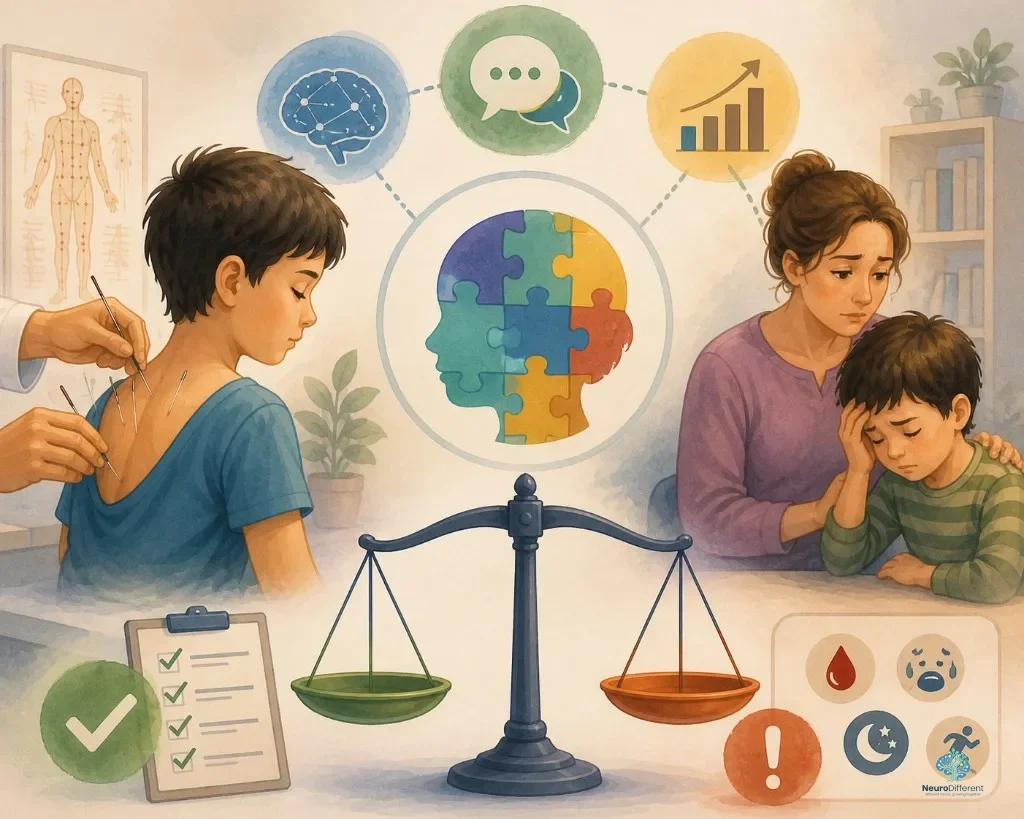
Current research does not provide strong evidence that acupuncture improves the main features of autism in children.
What the researchers did
Researchers reviewed studies where autistic children received:
- acupuncture,
- acupressure (pressure on body points without needles),
- or standard care for comparison.
They searched international and Chinese medical databases and found 10 studies involving 390 children between 3 and 18 years old.
The studies compared:
- real acupuncture with a fake or “sham” procedure;
- acupuncture plus usual care versus usual care alone.
Researchers looked at:
- core autism features;
- communication and language;
- learning and thinking skills;
- overall daily functioning;
- and possible side effects.
They also checked how reliable the studies were, because small or poorly designed studies can sometimes give misleading results.
What they found
In studies comparing real acupuncture with sham acupuncture, researchers did not find meaningful differences in core autism features.
Some studies reported small improvements in certain behaviors or skills, but the results were inconsistent.
There was no strong evidence that acupuncture improved communication or language abilities.
Some children experienced side effects, including:
- minor bleeding,
- crying because of fear or pain,
- irritability,
- sleep problems,
- increased hyperactivity.
Many of the studies were small, short-term, and used different methods, which makes the results harder to trust.
What this means for families and therapists
Right now, acupuncture cannot be considered a proven treatment for the main features of autism.
Some studies suggested possible benefits, but the evidence is too weak and inconsistent to draw firm conclusions.
This means:
- acupuncture should not replace approaches with stronger scientific support;
- claims of “guaranteed improvement” should be treated carefully.
If a family is still interested in trying acupuncture, it may help to discuss:
- possible benefits,
- stress or discomfort for the child,
- cost,
- and safety concerns with a qualified healthcare professional first.
Limitations
It is important to remember:
- all studies involved children only;
- most studies included small numbers of participants;
- follow-up periods were short;
- different studies measured outcomes in different ways.
Because of these limitations, researchers could not clearly determine whether acupuncture is helpful for autism.
The review authors said that larger and better-quality studies are still needed.
This is a simplified summary of Acupuncture for Autism: What Research Shows by Cheuk D.K, Wong V, Chen W.X et al., Cochrane Database of Systematic Reviews (2011). Source license: CC-BY-NC-4.0.
This is not medical advice. Please consult a qualified healthcare professional before changing therapy.