
In one sentence
This study suggests that certain patterns of brain activity measured at 10 months of age may be linked to how a child’s language skills develop over the following years.
What the researchers did
Researchers followed 159 infants from around 10 months old to age three. Some children had a higher likelihood of autism, often because they already had an autistic older sibling.
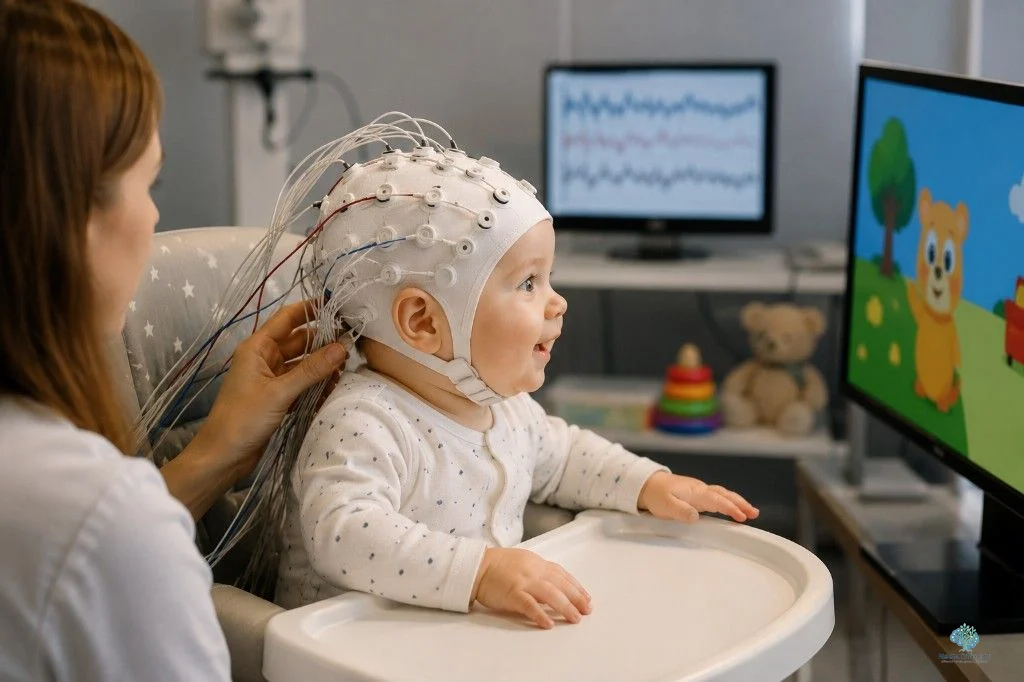
At several ages, researchers recorded EEG — a harmless brain activity test using a soft cap with sensors — while infants watched different videos.
The team focused on a type of brain activity called theta rhythm, which is thought to be related to attention, learning, and information processing.
At the same time, the researchers regularly assessed the children’s language development as they grew older.
What they found
The study found that theta activity measured at 10 months was linked to later language growth.
Children with elevated likelihood of autism, on average, showed slower language development over time than children in the comparison group. However, the connection between theta activity and later language growth looked similar in both groups.
The researchers suggest that this brain activity pattern may reflect something broader about how the brain supports language learning, rather than acting as a direct “autism marker.”
Importantly, the study does not mean that EEG can predict autism or tell parents exactly how a child will develop.
What this means for families and therapists
For families, the study is mainly a reminder of how rapidly the brain develops during infancy and how differently language can develop from one child to another.
This kind of EEG analysis is not currently used as a standard clinical test for autism or speech delay.
Still, the research gives scientists more clues about how early brain development may connect to later communication skills. In the future, findings like these might help identify children who could benefit from extra language support earlier in life — long before delays become obvious in daily conversation.
For now, researchers stress that parents should continue relying on everyday developmental observation, responsive interaction, play, and professional assessment if concerns arise.
Limitations and what we don't know yet
This was only one study, so the findings still need to be repeated and confirmed in future research.
The EEG recordings were also taken in a lab while infants watched videos, which may not fully reflect real-life learning, play, or communication at home.
Most importantly, the study shows a relationship between brain activity and language development, but it does not prove that one directly causes the other.
The research was also not designed to predict individual autism outcomes or future diagnosis.
This is a simplified summary of Theta Power at 10 Months of Age Predicts Developmental Change in Language in Infants With and Without an Elevated Likelihood for Autism by Papageorgopoulou E, Ali JB, Pasco G et al., Developmental science (2026).
Source license: CC-BY.
This is not medical advice. Please consult a qualified healthcare professional before making developmental or therapy decisions.