
In short
Cognitive behavioural therapy (CBT) is widely recommended for obsessive-compulsive disorder (OCD). But when OCD appears alongside autism, the scientific evidence becomes surprisingly thin.
A Cochrane review found that researchers still know very little about how well CBT works for autistic children and adults with OCD. After searching the medical literature, the authors found only one small randomized trial that met their standards.
That does not mean CBT cannot help. It means the research base is still far behind the reality faced by many families and clinicians.
Why this is more complicated than it sounds
OCD involves intrusive thoughts and repetitive actions that a person feels driven to perform, often to reduce anxiety or prevent something bad from happening.
Autistic people can also show repetitive behaviours, routines, and strong preferences for sameness. But these behaviours are not always driven by the same mechanisms as OCD compulsions. For some autistic people, repetition may help regulate stress, sensory overload, or uncertainty rather than relieve obsessive fear.
This overlap makes assessment difficult. Clinicians have to work out whether a behaviour is primarily related to autism, OCD, or a combination of both — because treatment approaches may differ.
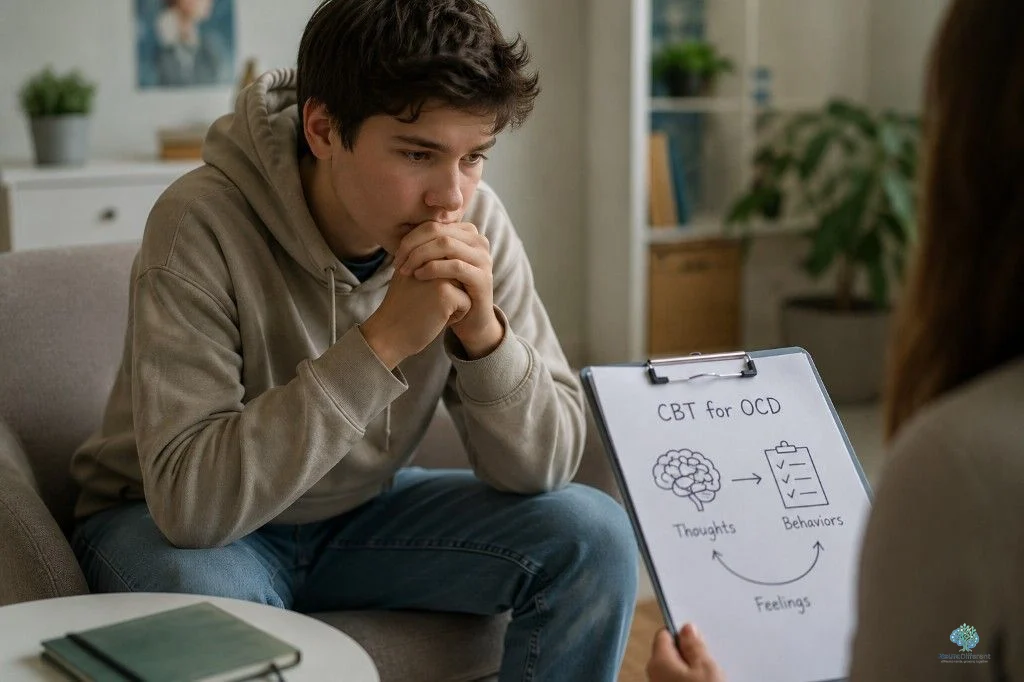
CBT is considered one of the standard treatments for OCD in the general population, especially approaches that include exposure and response prevention. But some clinicians have questioned whether traditional CBT works the same way when autism is also present, leading many services to experiment with adapted versions of therapy.
What the researchers looked for
The review team searched medical databases and clinical trial registries up to August 2020.
They were looking for randomized studies comparing behavioural therapy or CBT against waiting lists, usual care, placebo-style attention controls, or no treatment. The review included both children and adults diagnosed with autism and OCD, but excluded people with severe global intellectual disability.
The researchers originally hoped to combine evidence from multiple studies into a larger analysis. Instead, they found only one eligible trial involving 46 participants.
In that study, autistic participants with OCD received either CBT adapted to their needs or a shorter anxiety-management programme that did not include the full OCD-focused treatment approach.
What they found
The biggest takeaway from the review is how little evidence currently exists.
In the single available study, participants receiving adapted CBT may have experienced somewhat lower OCD symptom scores by the end of treatment compared with the comparison group. However, the difference was small, uncertain, and based on low-certainty evidence.
Around 87% of participants in both groups completed treatment, suggesting that the adapted therapy format itself was generally manageable for those involved.
The study also hinted at possible improvements in broader areas such as anxiety, depression, and quality of life, but again the evidence was too limited to draw firm conclusions.
Because no additional qualifying studies existed, the review authors could not perform a meta-analysis or compare findings across different clinics, age groups, or therapy styles.
What this means for families and therapists
For autistic children and adults who experience distressing compulsions or intrusive thoughts, the review does not suggest “therapy does not work.” Instead, it highlights how under-researched this area still is.
In practice, therapists often adapt CBT to better fit autistic clients. Sessions may use clearer and more concrete language, visual supports, slower pacing, predictable structure, or more involvement from parents and caregivers. Clinicians may also pay closer attention to sensory stress and communication differences during treatment.
The challenge is that many of these adaptations are already happening in real clinics long before strong research evidence has caught up.
For families, this means it is still reasonable to discuss treatment options with qualified professionals even though the evidence base is limited. The absence of large studies is not proof that support is ineffective — only that science has not yet provided strong answers.
What we still do not know
One small study cannot tell us whether CBT helps most autistic people with OCD, how durable the effects are over time, or which therapy adaptations matter most.
The participants in the included study were described in the original paper as relatively “high-functioning,” so the findings may not apply to autistic people with intellectual disability, limited speech, or higher support needs.
The review authors call for larger and better-designed studies that separate OCD symptoms from autism traits more carefully and examine how family involvement, communication style, and therapy adaptations influence outcomes.
Final thoughts
CBT remains one of the best-known therapies for OCD, but the evidence becomes much thinner once autism enters the picture.
Right now, clinicians and families are often working in a space where practical experience has moved ahead of formal research. That gap does not mean treatment is hopeless — it means the science still has catching up to do.
This is a plain-language summary of Behavioural and cognitive behavioural therapy for obsessive compulsive disorder (OCD) in individuals with autism spectrum disorder (ASD) by Elliott S.J, Marshall D, Morley K, et al., Cochrane Database of Systematic Reviews (2021). Source license: CC-BY-NC-4.0.
It is not medical advice — talk to a qualified clinician before changing therapy.