
"Why does he scream?" "Why can't she talk to me?" Siblings of autistic children ask honest questions. How you answer shapes whether they feel confused, jealous, protective, or ashamed of their family.
You do not need a perfect speech. You need repeated, calm messages matched to the sibling's age — and room for their feelings too.
What siblings often feel
Research and family reports suggest siblings may experience:
- confusion about unpredictable behavior;
- jealousy when parents' time tilts toward therapy or meltdowns;
- pride in knowing their sibling deeply;
- worry about the future;
- embarrassment in public — then guilt for feeling embarrassed.
Naming feelings ("It's okay to be upset when plans change") prevents siblings from hiding resentment or blaming themselves.
Language for young children (roughly 3–7)
Keep it concrete and non-blaming:
- "Your brother's brain works differently. Loud stores are harder for him than for you."
- "She isn't ignoring you — sometimes finding words takes longer."
- "When he covers his ears, his ears are telling him the sound is too big."
- "We use picture cards to help her know what happens next."
Avoid "sick," "broken," or "bad behavior." Use "different," "needs help," "works hard at…"
Language for older children and teens
They can handle nuance:
- autism as a lifelong neurodevelopmental difference, not a tragedy;
- co-occurring strengths — memory, honesty, deep interests;
- privacy — not sharing their sibling's diagnosis with friends without family agreement;
- ableism they may hear at school and how to respond or walk away.
Invite questions after meltdowns when everyone is calm, not in the crisis moment.
Fairness is not always sameness
Siblings notice different rules: "Why does he get the tablet after a meltdown?" Explain that different needs sometimes mean different supports — not that one child is favored.
Where possible, protect one-on-one time with the sibling, even 15 minutes weekly. Predictable special time reduces rivalry more than equal minute-counting.
Books, shows, and social stories
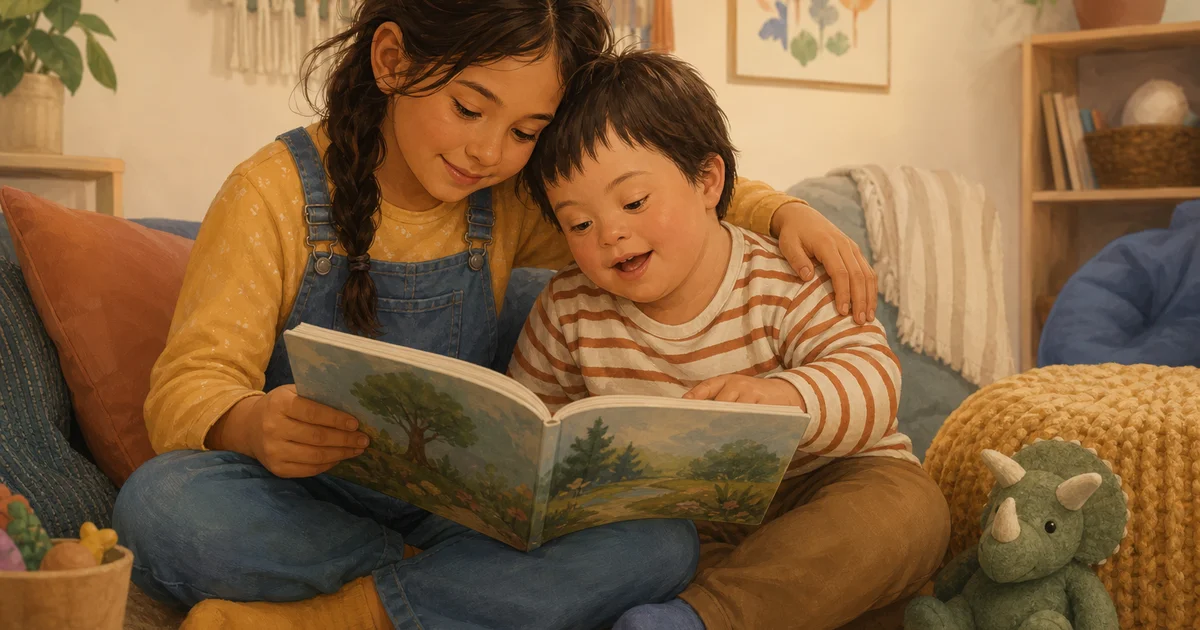
Picture books about neurodiversity (choose ones written or reviewed by autistic people when possible) give neutral vocabulary. Short social stories customized with your children's names can explain: "When Alex flaps his hands, he is excited. You can flap too or give a thumbs up."
When siblings need extra support
Signs a sibling is struggling: sleep changes, school decline, aggression toward the autistic child, withdrawing from family. A school counselor, family therapist, or sibling support group may help — especially when stress is chronic.
What to avoid
Making the sibling a third parent ("always watch your brother"). Venting adult fears about prognosis to a child. Expecting the sibling never to be annoyed — normal friction is still normal.
This week
Ask the sibling one question: "What do you wish you understood about [name]?" Answer in one sentence they can repeat. Small honest exchanges build a safer family story than one big talk.