
In short
A small US study suggests that online self-compassion and mindfulness training may help mothers — including mothers of autistic children — feel kinder toward themselves and emotionally healthier.
At the same time, the course did not clearly reduce parenting stress or the everyday pressures families were dealing with. The researchers describe the findings as early and preliminary, not proof of a major clinical effect.
Why researchers became interested in this topic
Parents of autistic children often describe living under constant pressure. The stress usually comes from far more than parenting alone: long waiting lists, therapy coordination, school concerns, financial strain, paperwork, and the feeling of always needing to advocate for support.
Many parents also report becoming highly self-critical over time. They may feel guilty for being exhausted, worry they are “not doing enough,” or struggle to give themselves the same compassion they would naturally offer another parent in the same situation.
Self-compassion training tries to address that pattern. The goal is not “positive thinking” or pretending life is easy. Instead, these programs teach people to notice stress and emotional pain without immediately responding with shame or harsh self-judgment.
Online courses are especially attractive for caregivers because they can be completed at home and fitted around unpredictable schedules.
What the researchers did
Researchers in the United States recruited mothers of infants and toddlers between 8 and 23 months old through autism support networks and social media.
Some families had at least one autistic child — either formally diagnosed or strongly suspected by healthcare providers. The comparison group reported no close autistic relatives.
A total of 67 mothers completed the first set of questionnaires. Depending on the specific measure, between 27 and 44 mothers also completed surveys both before and after taking an online course called The Gift of Self-Compassion.
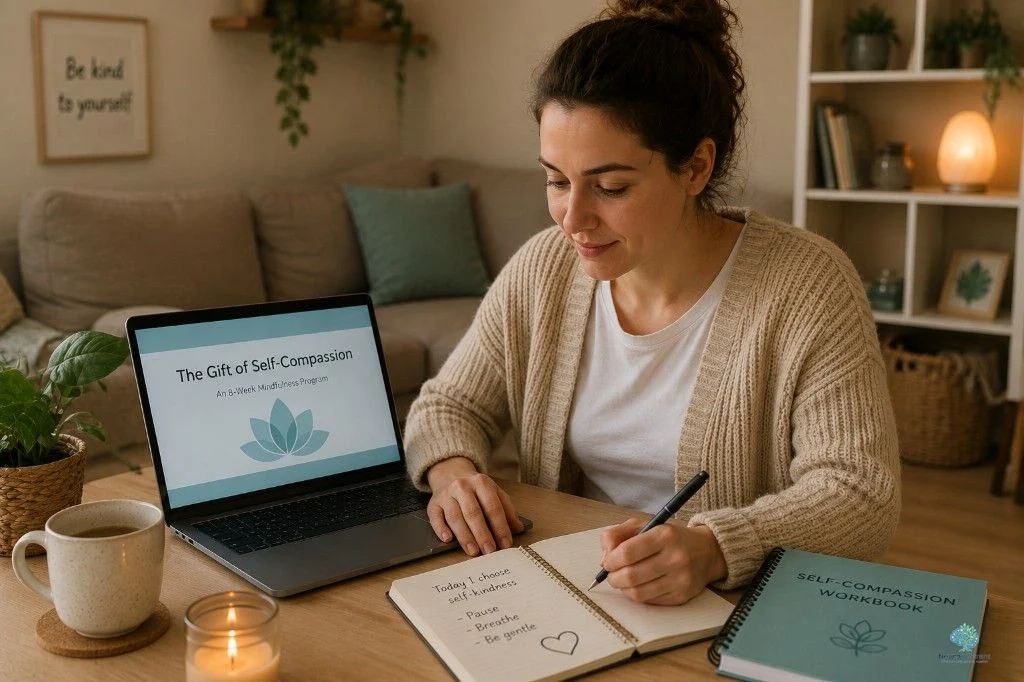
The course included videos, guided mindfulness exercises, reflective prompts, and workbook activities designed to encourage a more supportive inner dialogue.
Researchers measured self-compassion, general wellbeing, parenting stress, daily hassles, and family quality of life before and after participation.
One important limitation is that there was no separate “no-course” control group. Because of that, the study cannot prove that the course itself caused any changes that appeared later.
What they found
Before the course even began, mothers of autistic children reported noticeably higher parenting stress and more day-to-day difficulties than the comparison group. They also described lower family quality of life on average.
After the course, participants who completed the follow-up assessments showed higher self-compassion scores and better scores on a broader wellbeing measure sometimes called “flourishing.”
In simple terms, many mothers appeared to become somewhat gentler toward themselves and emotionally steadier.
But the course did not clearly reduce parenting stress, practical daily burdens, or broader family-life difficulties.
That distinction matters. Emotional coping may improve even while external pressures remain exactly the same.
Researchers also did not find evidence that mothers of autistic children benefited dramatically more — or less — than other mothers in the study. The general pattern of change looked fairly similar across groups.
What this may mean for families
The study offers a cautious but realistic message.
Mindfulness and self-compassion training are not substitutes for respite care, financial support, accessible services, or practical help. A parent overwhelmed by waiting lists, bureaucracy, sleep deprivation, or constant coordination work still faces those realities after the course ends.
At the same time, emotional support tools may still matter. For some parents, learning to respond with less self-blame and less emotional exhaustion can make daily life feel more manageable, even when circumstances do not immediately improve.
That does not “solve” stress. But it may slightly reduce the feeling of carrying it alone.
Limitations and what we still do not know
This was a small and early study involving only mothers, mostly from one region of the United States, with very young children. The findings may not apply to fathers, older autistic children, or families in other healthcare systems.
Because there was no control group, researchers cannot rule out other explanations for improvement — including unrelated life changes or the simple passage of time.
The study also did not examine whether the effects lasted months or years later.
The authors argue that larger randomized studies are needed, especially ones that combine emotional-support approaches with real improvements in family services and caregiver support.
Final thoughts
This study does not show that self-compassion training “fixes” parenting stress in autism. What it suggests instead is something more modest — and perhaps more realistic.
Even when external pressures remain heavy, some parents may benefit from learning to treat themselves with a little more patience, softness, and emotional care.
For families living under chronic stress, that may not be a complete solution. But it can still matter.
This is a plain-language summary of Evaluating an online self-compassion-based mindfulness course for mothers of autistic children by Barnum J., Blackham M., Hollingshead M., et al., Frontiers in Psychology (2026). Source license: CC-BY-4.0.
It is not medical advice — talk to a qualified clinician before changing therapy.