
In one sentence
This review suggests that music therapy may help some autistic children with overall development and emotional engagement, although effects on specific communication skills are still less clear.
What the researchers did
Researchers updated a large Cochrane review that included 26 studies involving more than 1,100 autistic children and young people.
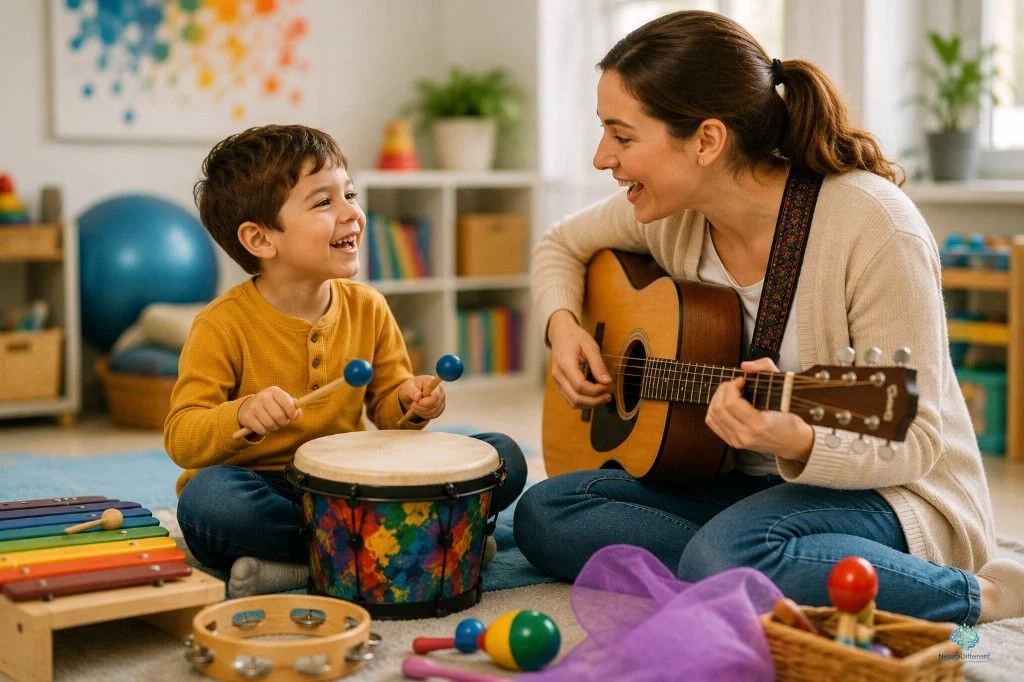
In most studies, sessions were led by trained music therapists. Children took part individually or in groups using singing, rhythm, instruments, movement, and shared musical play.
The researchers compared music therapy with standard care, other activities, or no additional intervention.
They wanted to understand whether music therapy could help with areas such as:
- overall development;
- autism-related difficulties;
- social interaction;
- communication;
- and quality of life.
What they found
Overall, children receiving music therapy were more likely to show improvement in broad measures of development and wellbeing compared with children in comparison groups.
The review also found signs that some autism-related difficulties became less severe after therapy. Quality of life scores were slightly better in some studies as well.
However, when researchers looked at very specific skills — such as verbal communication, nonverbal communication, or social interaction immediately after treatment — the results became less consistent. Some studies showed benefits, while others showed little difference.
The authors stress that music therapy does not appear to be a “universal solution” that works the same way for every child. But for some children, especially those who naturally connect through rhythm, sound, or musical interaction, it may become a meaningful part of support.
Importantly, the studies did not show clear evidence of serious harm or increased side effects related to music therapy.
What this means for families and therapists
For many autistic children, music can feel more natural, predictable, and emotionally comfortable than direct spoken interaction.
Some children may find it easier to:
- engage with another person;
- share attention;
- express emotions;
- or participate socially through rhythm and musical play.
Because of this, music therapy may help create connection and emotional engagement in a less pressured way.
The review also highlights that the research involved trained music therapists, not simply listening to music casually at home. Therapy sessions were structured and adapted to each child’s needs.
At the same time, music therapy is usually viewed as something that complements other forms of support rather than replacing them.
Limitations and what we don't know yet
Most studies only measured children shortly after therapy ended, so researchers still know little about long-term effects over many years.
The studies also varied a lot in age groups, therapy style, session length, and support needs, which makes it harder to predict how much one specific child might benefit.
For communication outcomes in particular, the evidence was still considered low quality, meaning future studies could change the current conclusions.
There is also very little research involving autistic adults.
This is a simplified summary of Music therapy for autistic people by Geretsegger M, Fusar-Poli L, Elefant C et al., Cochrane Database of Systematic Reviews (2022).
Source license: CC-BY-NC-4.0.
This is not medical advice. Please consult a qualified healthcare professional before making therapy decisions.