
In one sentence
Structured social-skills groups may help some autistic children and teenagers feel more confident around peers, but the evidence is still limited and based mostly on small US studies.
What the researchers looked at
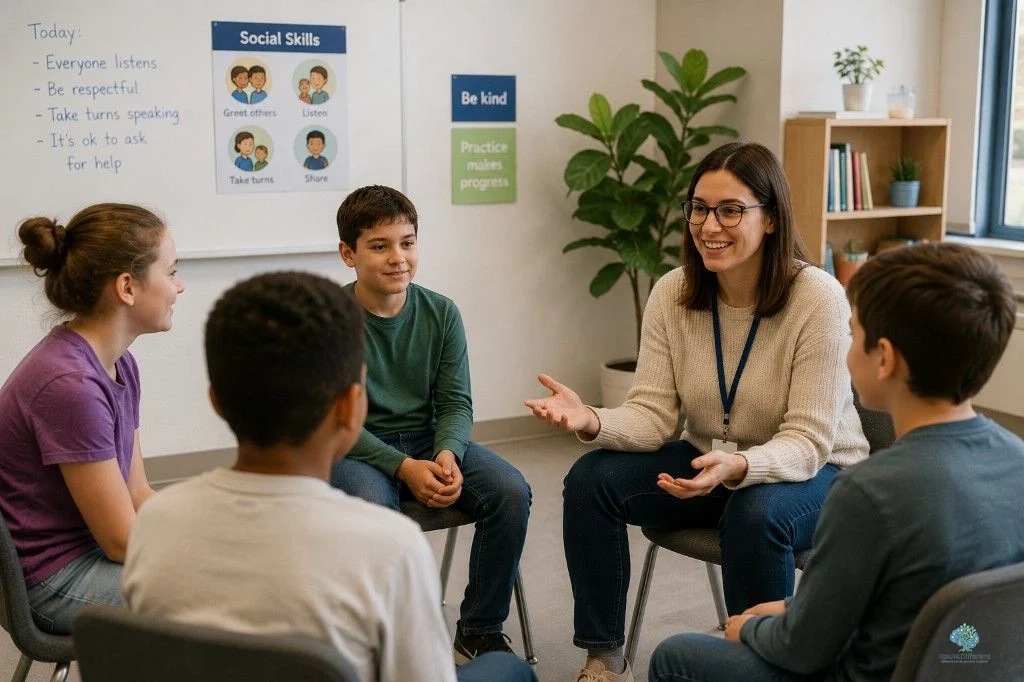
Many autistic children and teens want friendships and connection but find social situations exhausting, confusing, or unpredictable. Because of this, schools and clinics often recommend social-skills groups — regular sessions where young people practice conversation, play, cooperation, or friendship skills with peers and adult facilitators.
The Cochrane reviewers wanted to know how strong the evidence actually was.
They searched medical databases for randomised studies published up to December 2011. The review included autistic participants aged 6 to 21 and compared social-skills groups with waiting lists, usual care, or no special intervention.
Researchers looked at several outcomes, including:
- overall social competence;
- friendship quality;
- loneliness;
- emotion recognition;
- understanding of figurative language;
- mood and depression.
In the end, only five randomised studies met the criteria, covering 196 participants in total.
What they found
Overall, the studies suggested that social-skills groups may provide a modest improvement in social competence compared with control groups.
Some children also appeared to develop slightly better friendship quality after participating in group sessions. One study reported lower feelings of loneliness after treatment.
But the results were far from dramatic or consistent across every area.
For example, studies looking at recognising emotions from facial expressions produced mixed findings. Understanding conversational idioms was measured in only one study and showed no meaningful improvement.
The review also did not find convincing evidence that the groups improved depression in either children or parents.
Importantly, the included studies did not report major harmful effects from participation.
What this means for families
For families considering a social-skills group, the review offers cautious encouragement rather than a guarantee.
Some autistic children may benefit from practicing interaction in a more structured and predictable environment. A supportive group can sometimes make social situations feel safer and less overwhelming, especially when children share similar experiences.
At the same time, not every group works for every child.
A program is more likely to help when it matches the child’s communication style, sensory profile, interests, and energy levels. Real-life practice also matters: skills learned in a therapy room do not automatically transfer to school, hobbies, or friendships outside the group.
What this means for therapists and educators
The review also highlights an important point: social communication is not just about teaching “correct” behaviour.
A child learning scripted phrases or forced eye contact does not necessarily feel more comfortable socially.
Better programs usually focus on helping children communicate in ways that are meaningful and sustainable for them — while respecting autistic differences rather than simply trying to make behaviour look more “typical.”
Social-skills groups may be useful tools, but they are only one part of support.
Limitations and what we still don’t know
The evidence base was small.
All five studies took place in the United States and mostly involved school-age autistic children with average or above-average intelligence. That means the findings may not apply equally to autistic adults, minimally speaking children, or people from different cultural backgrounds.
The review is also more than a decade old. Newer programs may use different approaches, including interest-based groups, neurodiversity-informed practices, or more natural social settings.
Several studies also had a relatively high risk of bias because participants and researchers often knew who received the intervention.
The authors called for larger and better-designed studies, especially research looking at long-term wellbeing and quality of life rather than only short-term test scores.
Final thoughts
Social-skills groups are not a universal solution, but they may help some autistic young people feel more confident and connected.
The biggest difference may come not from “training children to act normal,” but from creating safer spaces to practice communication, build friendships, and explore social interaction without constant fear of failure.
This is a plain-language summary of Social skills groups for people aged 6 to 21 with autism spectrum disorders (ASD) by Reichow B, Steiner A.M, Volkmar F, et al., Cochrane Database of Systematic Reviews (2012). Source license: CC-BY-NC-4.0.
It is not medical advice — talk to a qualified clinician before changing therapy.