
In one sentence
This perspective paper argues that when autistic children stay focused on apps, robots, or virtual reality, researchers may be measuring attention rather than motivation, and the difference matters.
What the researchers did
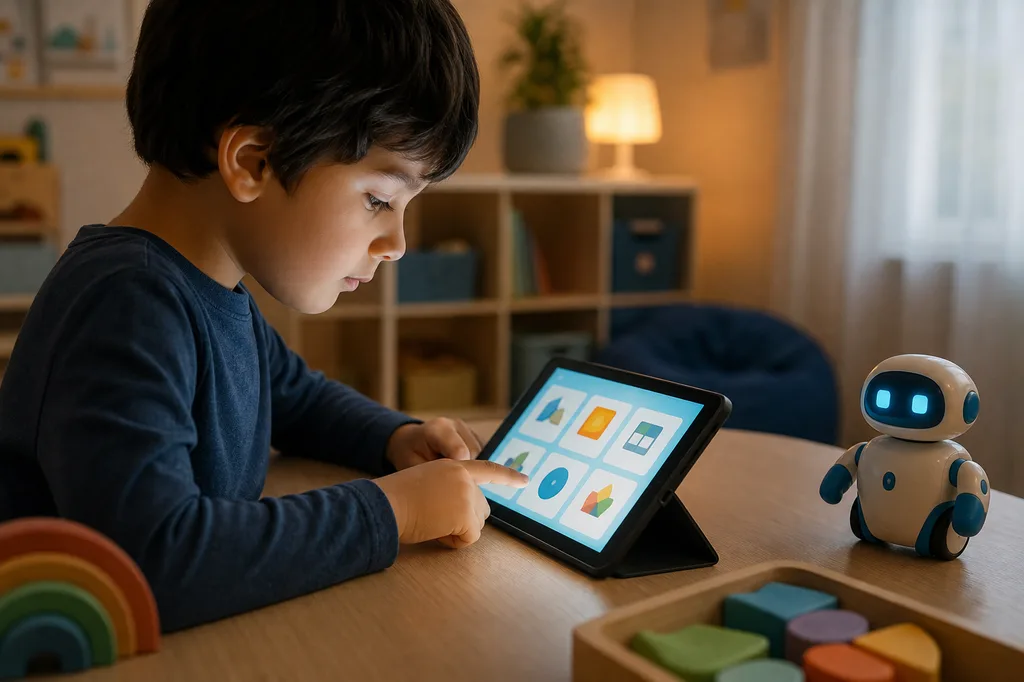
This paper was not a clinical trial and did not test one specific therapy. Instead, it was a perspective article about how autism researchers talk about "engagement" in digital interventions. That includes technologies such as tablet apps, social robots, virtual reality systems, and other computer-based tools used in support or assessment.
The authors looked at a common pattern in this field: when autistic children spend more time looking at, touching, or interacting with a technological system, that behaviour is often described as higher motivation or stronger engagement. On the surface, that sounds reasonable. But the paper argues that these terms are often used too loosely.
The authors suggest that a child may stay with a digital task for many reasons. They may genuinely enjoy it. They may find it predictable and easier to process than face-to-face interaction. They may be interested in visual patterns or repetition. Or they may simply be paying sustained attention without being especially motivated in the deeper sense of wanting a goal, reward, or social connection.
The paper's main goal is conceptual clarity: to separate related ideas that are often blended together in autism technology research.
What they found
The central argument is that "engagement" is not always the same as motivation.
According to the authors, many studies treat observable behaviour - for example, longer screen time, more gaze to a robot, or more repeated interaction with a digital tool - as if it automatically proves that the child is motivated. But those behaviours may reflect sustained attention, curiosity, familiarity, sensory preference, or reduced social pressure rather than motivation itself.
This matters because digital tools are often praised for being highly engaging for autistic children. That may be true in an everyday sense, but if researchers do not define what kind of engagement they mean, findings can become blurry. A child who remains focused on a robot for ten minutes may be showing interest, comfort, attention, or motivation - and those are not interchangeable ideas.
The paper calls for more careful measurement. Instead of assuming that visible involvement equals motivation, researchers should be clearer about what exactly they are measuring and why. They may need to combine behavioural observations with better theory, more precise definitions, and outcome measures that separate attention from motivational drive.
What this means for families and therapists
For families and therapists, the paper offers a useful reminder: a child being absorbed by technology does not automatically mean the technology is the best learning tool or that it is increasing motivation in a meaningful way.
That does not mean digital supports are unhelpful. Many autistic children do respond well to apps, robots, or virtual environments because those tools can feel predictable, structured, and less socially demanding. In practice, that can make participation easier and reduce stress. Those are real advantages.
But if a programme claims to improve motivation, it should be able to show more than prolonged attention or repeated use. Ideally, it should show that the child is choosing to engage, pursuing a goal, transferring that engagement into learning or communication, or staying involved for reasons that go beyond simple attentional capture.
In short, the paper encourages adults not to confuse "my child stayed with it" with "my child was truly motivated by it." Sometimes those overlap, but not always.
Limitations and what we don't know yet
Because this is a perspective paper, it does not provide new experimental data. Its strength is theoretical: it highlights a measurement problem and proposes a more careful way of thinking about it.
That means the next step is not to accept the paper's argument as settled fact, but to test it. Future studies need clearer definitions of engagement, motivation, attention, and preference, along with measures that can tell those processes apart.
If researchers do that well, families and clinicians will get more useful answers about when digital tools truly support autistic children and when they mainly hold attention without producing broader benefit.
This is a simplified summary of the perspective paper available here by Meduri A, Marraffa C, Roccaforte G et al., Frontiers in Digital Health (2026).
Source license: CC-BY-4.0.
This is not medical advice. Please consult a qualified healthcare professional before making therapy decisions.