
Many parents of autistic children know the pattern: long evenings, repeated wake-ups, early starts, or a child who seems wired when everyone else is winding down. Sleep problems are among the most common complaints in autism — not because parents are doing something wrong, but because the same brain differences that affect communication and sensory processing often affect sleep regulation too.
This guide focuses on what you can change at home. It is not medical advice; if sleep is severely disrupted or your child snores, gasps, or seems unwell at night, involve your pediatrician.
Why sleep is often harder
Several factors overlap. Sensory sensitivity can make pajamas, sheets, room temperature, or a sibling's noise unbearable. Difficulty with transitions means "bedtime" may feel abrupt and threatening. Anxiety about tomorrow, separation from a parent, or a change in routine can keep the nervous system alert.
Some autistic children have a shifted circadian rhythm — they naturally feel sleepy later and wake earlier than peers. Others wake fully alert at 3 a.m. and cannot return to sleep without help. Reduced melatonin production has been reported in some studies, which is one reason clinicians sometimes discuss melatonin supplements — always under medical guidance and appropriate dosing for children.
Build a predictable wind-down
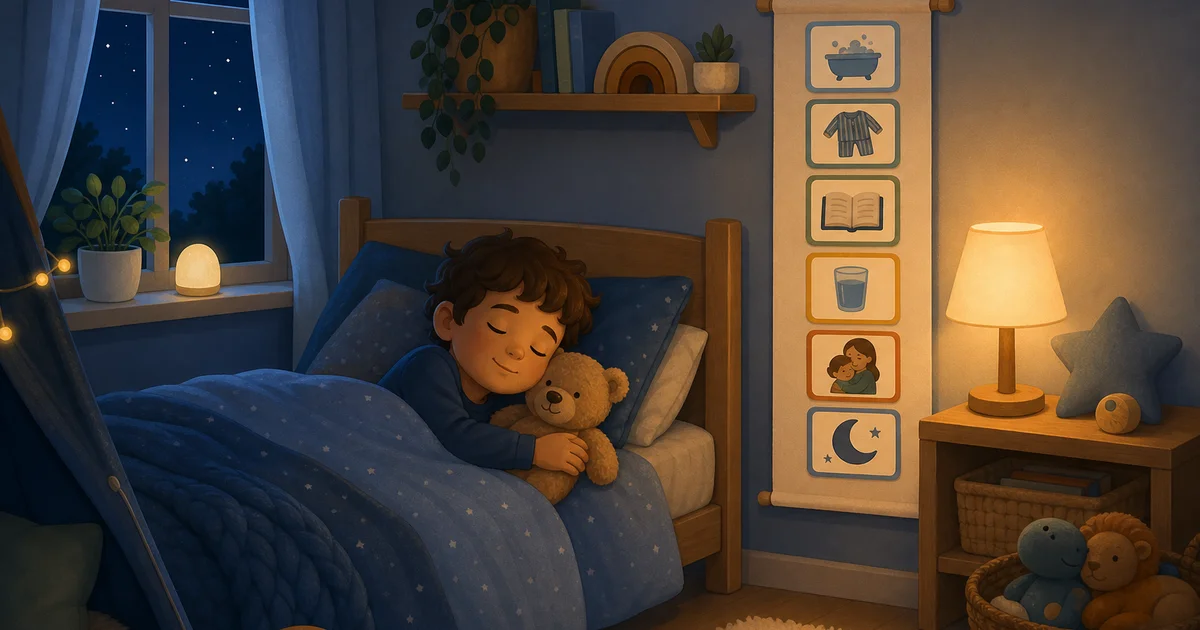
Autistic children usually benefit from the same sequence every night, shortened to what you can sustain:
- Last screen or active play ends at a fixed time (visual timer helps).
- Bath or wash — only if your child finds it calming, not stimulating.
- Pajamas chosen for comfort: tagless, soft seams, no scratchy elastic.
- Same short phrase each night: "Sleep time," not a long explanation.
- One or two calm activities: quiet book, low light, familiar music or white noise.
- Parent leaves or stays — whichever your child needs — but the order stays the same.
Picture cards for "bath," "pajamas," "story," "sleep" reduce the number of verbal demands at a tired hour.
Make the bedroom a sensory fit
Check the basics before adding new rules:
- Light: blackout curtains or a dim night light — whichever your child tolerates. Some children need total darkness; others panic without a soft glow.
- Sound: white noise, fan, or ear protection if household noise is unavoidable.
- Temperature: cooler rooms often help; heavy blankets or weighted covers may soothe some children and overwhelm others.
- Touch: trial different fabrics. Compression pajamas help some; others need loose cotton.
Remove clutter and flashing electronics. A visual "sleep zone" — same bed, same pillow, same blanket — signals safety through sameness.
Daytime habits that support night sleep
Physical activity during the day — jumping, walking, swimming, trampoline — often improves sleep, but finish vigorous play at least one to two hours before bed. Regular meal times stabilize blood sugar; a small protein snack before sleep can help some children who wake hungry.
Limit caffeine hidden in chocolate or cola. Keep wake-up time consistent even after a bad night; sleeping in heavily on weekends can reset the rhythm in the wrong direction.
When your child wakes at night
Stay calm and boring. Bright lights, long conversations, and tablets turn wake-ups into rewarding events. Use minimal words, dim light, and the same script: "It is still sleep time. I am here."
If your child comes to your bed and that works for your family, it is a valid choice — consistency matters more than ideology. If you want them in their own bed, return them gently every time with the same brief phrase; progress is measured in weeks, not nights.
Track patterns for a week: time of waking, what happened before bed, illness, growth spurts. Data helps you and your clinician see triggers.
When to involve a doctor
Consult your pediatrician if:
- sleep loss affects safety, school, or your child's health;
- you hear snoring, pauses in breathing, or restless legs;
- meltdowns at bedtime are daily and extreme despite environmental changes;
- you are considering melatonin, sedating medication, or sleep studies.
Melatonin helps some autistic children fall asleep faster in research trials, but dosing, timing, and long-term use should be supervised. Medication is a tool, not a substitute for a sensory-friendly routine.
What to avoid
Long bargaining at bedtime teaches that resistance extends the day. Punishing night waking adds fear to an already overloaded nervous system. Sudden total schedule overhauls without visual preparation usually backfire.
Forcing a child to stay in bed while pajamas or the room feel wrong addresses behavior, not cause.
Pace of change
Improve sleep in small steps: five minutes earlier wind-down for a week, one new picture card, one fabric swap. Celebrate any night that goes slightly better. Sleep habits shift slowly — stability beats perfection.