
In one sentence
Some autism interventions can improve performance on tasks related to emotion recognition or understanding other people’s perspectives, but this review found weak evidence that those gains consistently carry over into everyday social interaction.
What “Theory of Mind” means
“Theory of Mind” (often shortened to ToM) is a psychology concept about understanding that other people may think, feel, believe, or want something different from you.
For example, it includes noticing that someone is upset even if they do not say it directly, or understanding that a joke is not meant literally.
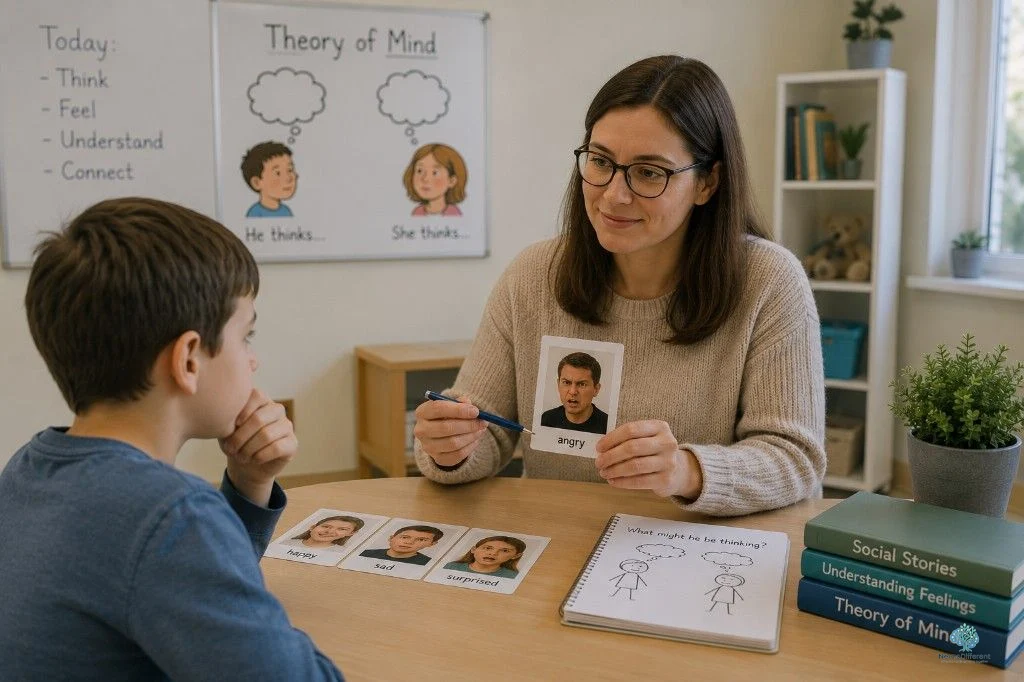
Researchers have long linked difficulties in these areas to autism. Because of that, many therapies and educational programs were designed to try to strengthen skills such as:
- recognising emotions;
- understanding intentions;
- joint attention;
- imitation;
- interpreting social situations.
Some programs use games and role play. Others rely on pictures, videos, computer exercises, or therapist-led lessons.
What the researchers did
The Cochrane review searched for randomised controlled trials published up to August 2013 involving autistic participants.
In total, the review included 22 studies with 695 participants.
The studies were very different from one another. Some focused on recognising facial expressions, while others trained joint attention, imitation, or explicit “Theory of Mind” reasoning.
Participants also varied in age, support needs, and therapy format, making it difficult to compare studies directly.
Where enough studies used similar methods, researchers combined the results in meta-analyses.
What they found
Overall, the evidence was mixed and often rated as low or very low quality.
Some interventions improved performance on narrow tasks related to the skill being trained. For example, programs focused on recognising emotions from photographs sometimes helped participants perform better on emotion-recognition tests afterward.
Joint attention training also showed some positive effects in a few therapist–child interaction studies.
But the bigger question was whether those improvements changed everyday life outside the training setting.
Here the evidence became much weaker.
A child might become better at identifying emotions in structured exercises without finding friendships, conversations, or classroom interaction noticeably easier in daily life.
Results for broader communication and social functioning were inconsistent across studies, partly because each study measured different things in different ways.
Researchers also found very little evidence that gains lasted over long periods of time.
No harmful effects were reported in the reviewed trials.
What this means for families
Families often encounter programs advertised as teaching empathy, social understanding, or “mind reading.”
This review suggests keeping expectations realistic.
Some children and teenagers may benefit from practising specific social skills in a structured environment. Learning to recognise emotions, take turns in conversation, or notice social cues can still be useful.
But these programs should probably not be viewed as complete solutions for the social challenges linked to autism.
Real-world communication is complicated, unpredictable, and emotionally demanding. Doing well on therapy exercises does not automatically translate into feeling comfortable with peers at school or building close friendships.
For many autistic people, supportive environments, shared interests, predictable relationships, and reduced social pressure may matter just as much as formal social-skills teaching.
What this means for therapists and educators
The review does not say Theory of Mind-based interventions are useless.
Instead, it suggests they may work best when goals are narrow, practical, and measurable — for example, helping a child recognise facial expressions or practise specific interaction patterns.
The findings also highlight the importance of practising skills in natural settings, not only in therapy rooms.
Researchers noted that evidence for “generalisation” — carrying skills into everyday life — was limited. Because of that, programs may benefit from involving real peers, classrooms, play situations, or family routines rather than isolated drills alone.
Limitations and what we still do not know
Many studies were small and used different outcome measures, making the evidence difficult to combine.
Most of the research came from the early 2010s, before many newer digital tools and modern neurodiversity-informed approaches became widespread.
The review also cannot answer important practical questions, such as:
- which specific programs work best;
- which autistic people benefit most;
- whether improvements last for years;
- how these interventions interact with speech therapy, school support, or other approaches.
The authors concluded that larger and better-designed long-term studies are still needed.
Final thoughts
Theory of Mind interventions may help some autistic people build certain social-cognitive skills, especially in structured exercises and short-term testing situations.
But there is still limited evidence that training emotion recognition or perspective-taking automatically transforms the messy, fast-moving reality of everyday human interaction.
For many autistic people, quality of life may depend less on “perfectly reading minds” and more on being understood, accepted, and able to communicate in ways that feel natural and safe.
This is a plain-language summary of Interventions based on the Theory of Mind cognitive model for autism spectrum disorder (ASD) by Fletcher-Watson S, McConnell F, Manola E, et al., Cochrane Database of Systematic Reviews (2014). Source license: CC-BY-NC-4.0.
It is not medical advice — talk to a qualified clinician before changing therapy.