
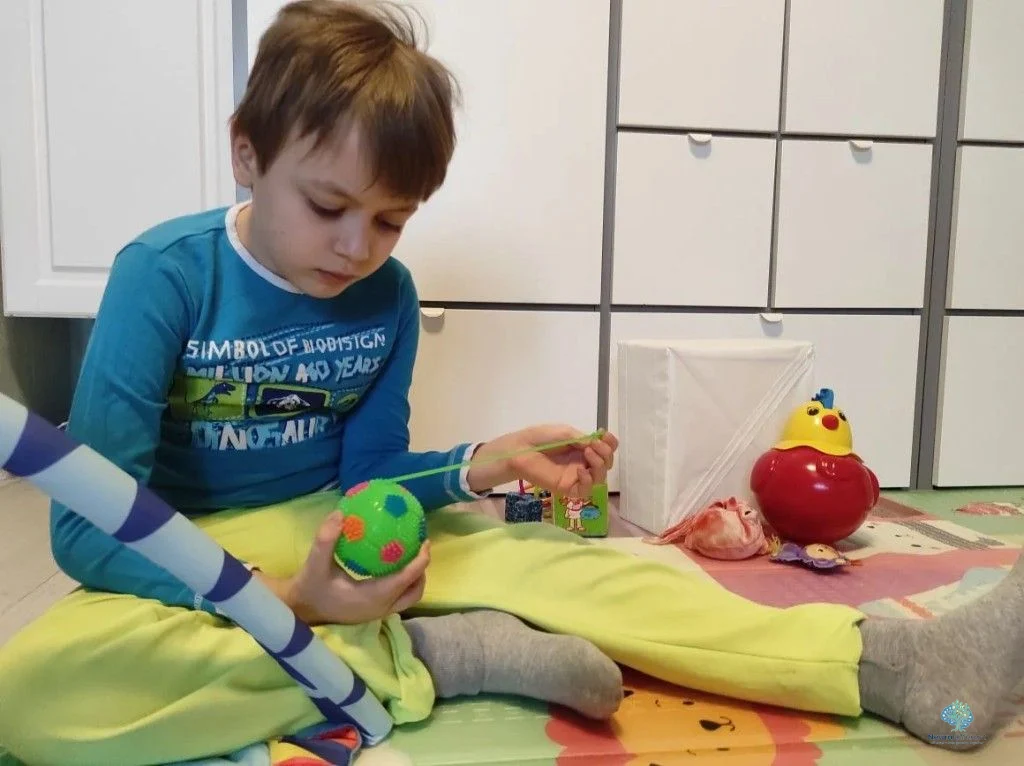
It is often hard to "keep a child busy" in the usual sense when a child has severe autism: long verbal instructions do not work, pretend play may not be meaningful, and spoken language may be only partly understood or not understood at all.
This does not mean a child cannot play or develop skills. It means they may need a different format: visual input, action, and repetition.
Main rule: show, do not over-explain
For many autistic children, these supports work best:
- a picture;
- a real object;
- a short model of the action ("do it like this").
Keep it to one short step. Use the same prompt each time. Repeat many times. First show the action, then help hand-over-hand if needed, and gradually reduce support.
1) Sensory activities: the foundation of calm
Sensory play is often one of the best ways to help a child stay engaged independently and for longer periods.
Example:
- prepare a container with rice or beans;
- add a spoon and a cup;
- model the action: scoop -> pour.
If needed, gently guide the child's hand and complete the action together, with minimal words.
Other options:
- pouring dry grains from one container to another;
- pouring water;
- finding hidden toys.
Why it helps: over time, the child starts doing more independently, becomes calmer, and can stay in activity longer.
2) Sorting: clear structure and clear result
Sorting tasks work well for many children because the outcome is concrete and visible.
How to start:
- place two containers;
- put red objects in one and blue objects in the other;
- guide the child's hand to pick up an item and move it to the correct container.
Repeat many times. With practice, the child becomes more independent.
3) Play with favorite items: do not break it, expand it
If a child already loves animals, cars, or other objects, you already have a strong starting point.
The key is not to replace their play style, but to add one small step:
- "feed" the toy;
- seat it in a chair or stroller;
- put it to bed and cover it;
- hide and find it.
Main principle: do not break the child's familiar way of playing - gently expand it.
4) Simple daily-life tasks with visual support
Sometimes practical home tasks work better than "games." But they must be very concrete.
The phrase "Put the laundry away" is often too abstract. "Put it here," while pointing to the exact place, is clearer.
How to teach:
- pick up the item;
- show exactly where it goes;
- let the child do it with physical guidance if needed;
- repeat in the same way several times.
Examples:
- putting clothes into a basket;
- wiping the table (with a modeled movement);
- carrying an item to another room.
This builds independence and helps the child understand the purpose of actions.
5) Tablet time: guide it, do not ban it
If a child likes a tablet, use it as a resource.
Approach:
- short videos;
- simple cause-and-effect apps ("tap -> something happens");
- occasional co-play with an adult (press together, take turns).
Even one shared action is already learning and connection.
A short visual daily routine
Children with autism often do better when daily activities follow a predictable pattern.
Example cycle:
- Sensory play
- Sorting
- Movement (walk, run, jump)
- Tablet time
- Calm play
You can make picture cards and show "now this."
What matters most
A child with severe autism is not lazy and is not ignoring you - they often do not understand abstract instructions.
That is why these tools work:
- visual support;
- repetition;
- short, simple tasks;
- predictable daily structure.
When you adapt activities to your child's way of processing the world, you are already giving meaningful support.