
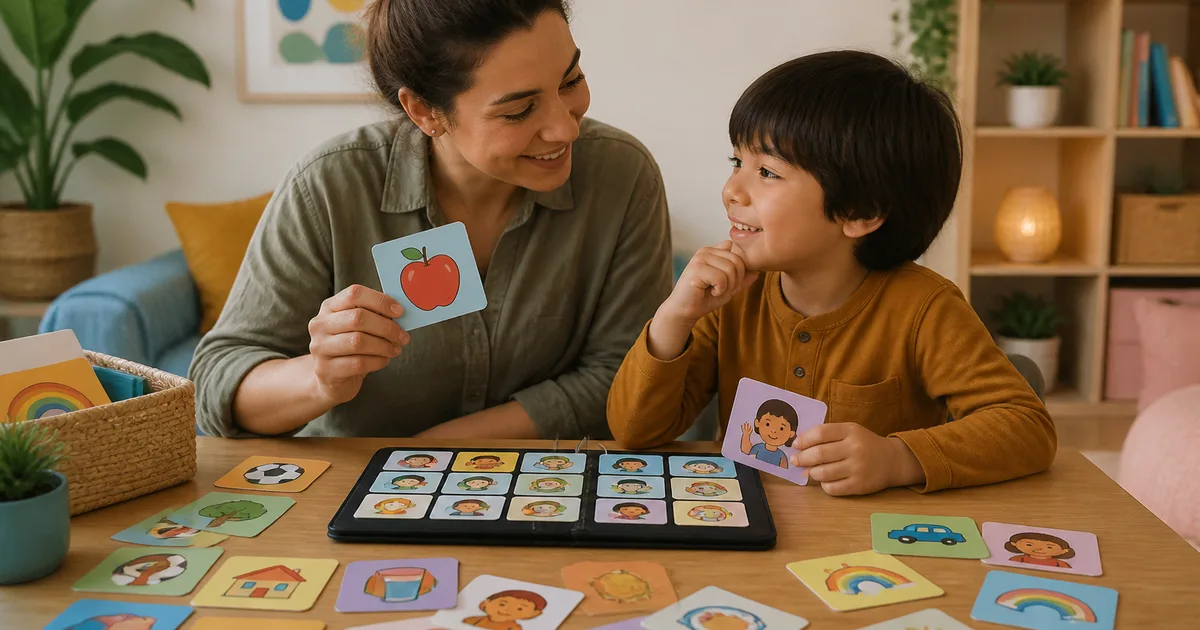
A child does not need spoken words to have something important to say. They may point, pull an adult toward the cupboard, repeat a line from a video, look away, cry, hand over an object, or become still. Visual communication cards can make those messages easier to notice and easier to answer. They are not a test the child must pass, and they are not a promise that every child will speak. They are a practical way to put choices, needs, comments, and boundaries where a child can reach them.
This guide explains how families can use pictures, written words, and spoken cards at home, on outings, and with school. It is educational information, not medical advice or an individualized speech-language plan. If your child loses skills, has swallowing concerns, or communication difficulties are affecting safety or wellbeing, speak with the clinician who knows them.
Key takeaways
- Visual cards can support understanding and expression; they are useful for speaking, minimally speaking, and non-speaking autistic children.
- AAC is not “giving up on speech.” Research and clinical practice do not support the fear that accessible communication prevents speech development.
- Start with words that give the child real power: help, stop, break, more, toilet, drink, and preferred people or activities.
- Model cards during real life without demanding imitation, pointing, eye contact, or speech.
- A small board that is used every day is more valuable than a large, perfect system kept in a drawer.
- Keep the same core words across home, school, and outings, while adapting the board to each setting.
- Respect all communication, including gestures, echolalia, body language, typing, signs, and a child’s decision not to answer.
What visual communication cards are
Visual communication cards are simple symbols, photographs, drawings, written words, or combinations of these that represent something meaningful. A card might show a glass of water, the word “break,” a photo of Grandma, or an icon for “all done.” A child may point to it, hand it over, look toward it, touch it on a device, or use it as a cue for what happens next.
Families use cards in several related ways. A choice board presents two or more options: apple or crackers, swing or bubbles. A request board holds words a child can use to ask for help or a preferred item. A routine board shows a sequence such as toilet, wash hands, snack. A feelings or regulation board makes “too loud,” “hurt,” “space,” or “hug” visible. A portable ring of cards can go to the shop, playground, car, or doctor’s office.
The pictures are not magic. Their value comes from a reliable social pattern: the child notices a card, an adult treats it as meaningful, and the environment responds. If “drink” consistently leads to a drink or an honest answer about when one is available, the card becomes useful. If a card is only used to make demands of the child, it becomes another adult instruction.
Some families prefer photos because they are concrete. Others use line drawings because they are quicker to print and easier to generalize. Older children may prefer written words, emojis, or typed notes. Follow what your child recognizes and accepts rather than pursuing the most fashionable format.
AAC, picture exchange, and speech: what is the difference?
AAC means augmentative and alternative communication. It is an umbrella term for every method that adds to or stands in for speech: gestures, sign language, picture cards, alphabet boards, speech-generating devices, typing, and written notes. “Augmentative” means adding support to speech; “alternative” means providing another route when speech is unavailable, unreliable, tiring, or unsafe.
Picture Exchange Communication System (PECS) is one branded, structured teaching approach that often begins with physically exchanging a picture to request a wanted item. Some families and professionals find elements of that approach useful. But visual communication is broader than PECS. You can use a home board without running a formal protocol, and a child should not be limited to requesting snacks or toys. Communication includes protesting, commenting, asking questions, sharing a joke, refusing, and saying “I don’t know.”
The common worry is, “Will cards stop my child from talking?” A communication support cannot take away a child’s need or ability to speak. For many children, reducing the pressure to find speech frees attention for connection. Some children speak more when they know they can fall back on a card; others continue to rely mostly on visuals, signs, or a device. Both outcomes deserve respect. The goal is not speech at any cost. The goal is reliable access to self-expression.
Do not remove a child’s cards to “motivate” spoken language. That turns communication into a reward controlled by adults. Keep every communication route available and respond warmly to attempts in any form.
Choose a useful first vocabulary
The best starter vocabulary is not a generic pack of fifty nouns. It is a small set tied to your child’s actual day and to messages adults need to hear. Begin with roughly six to twelve cards, then add words after you have used the first group consistently.
Start with core words, flexible words that work in many situations:
- more, again, finished, wait, go;
- help, stop, no, yes, mine;
- want, look, open, different;
- break, quiet, space, hug;
- hurt, toilet, drink, eat.
Then add fringe words, the people, places, foods, objects, and activities that matter to this child: their favourite video, bubbles, train, tablet, sister, playground, bath, apple, or trampoline. A “no” card matters even when it makes an adult’s plan less convenient. So do cards for discomfort, pain, and privacy.
Keep vocabulary functional but not narrowly transactional. A child who only has “I want” cards is being asked to perform a customer role all day. Include words for connection such as funny, love, look, hello, music, and your child’s interests. Include a way to say “not that” and “I changed my mind.” These words prevent cards from becoming another compliance chart.
Use photographs for highly specific choices, such as the exact blue cup or favourite snack. Pair a photo with a word when possible. That gives a child multiple cues now and a bridge toward broader categories later.
Make a starter board that survives real life
You do not need specialized equipment on day one. Print or draw pictures, cut them out, and attach them to paper, cardboard, a fridge, a small folder, or a key ring. Lamination and hook-and-loop fasteners help, but a phone photo, sticky note, or handwritten word can work in a hard moment. Accessibility matters more than aesthetics.
Put the first board where communication happens. A snack board belongs near the kitchen, not in a therapy bag. A break card should be reachable from the child’s usual work or play area. Keep it at the child’s height and bring it within reach if motor access is difficult. Do not make the child cross the room, get an adult’s attention, and speak before they may use a card; that defeats the point.
Build a simple home board with one row of needs and one row of preferred items. For example:
- Help, stop, more, finished, break, toilet.
- Drink, snack, tablet, outside, bubbles, music.
Add a “people” section if the child seeks specific adults. Add a “pain” or “body” section only with words you are prepared to take seriously. If a child selects “hurt,” respond by checking calmly, offering a familiar way to show where, and seeking clinical help when appropriate. A card does not diagnose a cause, but it can make a concern visible.
Review the board weekly. Remove nothing just because it was not used once; perhaps it was inaccessible or no opportunity arose. Replace items that have lost meaning and add words from repeated gestures, scripts, or conflicts. A board should grow from the child’s life, not from a catalogue.
Use cards for routines and transitions
Communication boards and visual schedules work together but do different jobs. A schedule tells a child what is likely to happen. A communication board gives the child a way to influence what happens. Both reduce the language load of a busy day.
For morning, use a short sequence: wake up, toilet, clothes, breakfast, bag, car. Keep a separate small board nearby with help, wait, different shirt, finished, and break. This distinction is important. A schedule cannot become a non-negotiable demand when the child is showing that socks hurt, the bathroom is overwhelming, or they need more time.
For meals, offer a choice card before food appears and a more/finished card during the meal. For bath, show wash, water, towel, stop, warm, and all done. For leaving home, bring cards for toilet, drink, snack, home, wait, help, and quiet. In a shop, “go home” may prevent an overload from becoming a meltdown. During a medical visit, cards for pain, stop, wait, and break can help adults recognize consent and distress.
Read our guide to visual schedules and transitions for more detail on making sequences predictable. The communication board remains the child’s voice inside that sequence.
Model without pressure
Modeling means you use the cards yourself while you speak naturally. At snack, touch or point to “more” and say, “More crackers?” When the child finishes a game, point to “finished” and say, “Finished blocks.” When you take a break, say, “I need quiet,” while touching the quiet card. You are showing that cards are ordinary language, not homework.
Avoid turning every interaction into a prompt. Repeatedly asking “What do you want? Say it. Point to it” can make communication feel like a quiz, especially for a child who is already overloaded. Instead, pause, make the board visible, notice gestures and looks, and offer a model: “You are looking at the door. Go outside?” Give enough wait time for processing. A child may respond after several seconds, not instantly.
Do not require eye contact, a full sentence, or a card exchange before meeting basic needs. If a child grabs your hand toward the fridge, you can honor that message and model “drink” or “snack” at the same time. If they use echolalia, listen for what the repeated phrase might mean and offer a card that fits the situation. Our guide to echolalia as communication explores why repeated language can carry a real message.
Praise the access, not the performance: “You told me break. Thank you for showing me.” That response teaches that communication works without making the child feel observed or graded.
Cards during distress, meltdowns, and shutdowns
Cards may help before or after overload, but they are not a demand to communicate during a meltdown. At the peak of distress, reduce noise, language, questions, and pressure. Keep a few familiar regulation cards visible only if that helps: water, toilet, space, hug, quiet, home, help. If the child pushes cards away, respect that too.
Teach those words during calm moments. A child is more likely to find “break” during rising stress if adults have modeled it while playing, eating, and resting. Watch for early signals: faster pacing, withdrawal, covering ears, repeated refusal, increased scripting, or a change in movement. Offer “break?” and make leaving possible before the nervous system is overwhelmed.
Cards do not replace safety planning or clinical care. Sudden aggression, self-injury, pain, or prolonged distress deserves careful support from the adults and clinicians involved. For immediate home strategies, see how to calm a child during a meltdown and prevent it. The key principle is simple: communication support should lower pressure, never become a condition for comfort.
Take communication beyond the kitchen
Many systems fail because they live only on a wall at home. Generalization works best when the core vocabulary travels. Make a small outing board with durable cards or save a matching page on a phone or tablet. Keep it predictable: same symbols, same words, same place in the bag.
At the playground, include swing, stop, again, toilet, drink, snack, home, wait, help, and hurt. In the car, add music, quiet, window, stop, sick, and home. For a relative’s house, include favourite foods, the bathroom, a calm room, and trusted people. At school, make sure the child can use their system during lessons, lunch, playground time, and discipline conversations—not only in speech sessions.
Before a new outing, show a small “first/then” board: first car, then library; first shop, then home. Offer a way to decline or ask for change. The child may not be able to alter every plan, but an honest response is better than pretending choice exists. “We need ten more minutes. Then home,” paired with a visual timer, respects the message while giving a clear boundary.
If your family needs portable, spoken-card practice, Speaking Cards offers a focused place to build and use everyday prompts. It is a support tool, not a substitute for a speech-language professional. You can find it alongside other family tools in NeuroDifferent Apps.
Share one communication plan with school and caregivers
Consistency does not mean every adult must use cards perfectly. It means the child should not have to learn a different language in every room. Send a one-page introduction to teachers, grandparents, babysitters, and therapists. Include a photo of the board, the words the child uses most, how they access it, how long they may need to respond, and what adults should do when the child selects “stop,” “help,” or “break.”
Name strengths as well as needs. “Uses a train photo to start shared play,” “can read written choices,” or “points after about ten seconds of wait time” helps adults see competence. Explain what not to do: do not withhold a desired item until speech happens, do not remove the board after a refusal, and do not assume a child understands less because they do not answer verbally.
Ask school where the board will live, who will model it, and how it travels to lunch, playground, and specialist lessons. If a child uses a device, ensure it is charged and available, not locked in a cupboard as a “reward.” Communication is an accommodation, not a privilege.
Parent and school collaboration is especially important when behaviour is being misunderstood. A refusal may be a request for a break. A child leaving a table may be communicating “too loud.” The communication interventions guide for minimally verbal autistic children can help families ask for supports that expand communication rather than merely reduce visible behaviour.
Common myths that make cards harder to use
“Cards are only for children who cannot talk.” Speaking children can use visuals when speech disappears under stress, when choices are complex, or when visual information is simply easier to process. Adults use calendars, maps, and text messages for the same reason.
“We should wait until the child is ready.” A child does not need to prove readiness for access to language. Begin by making a few meaningful words available and modeling them. Participation can be gradual.
“They only use cards to ask for treats.” That usually reflects the words and opportunities adults have provided. Add protest, comment, connection, sensory, and information words; model them in ordinary life.
“If I honor ‘stop,’ they will control everything.” Honoring a message does not mean every request becomes possible. It means you acknowledge it, reduce unnecessary pressure, and state limits clearly. “Stop homework” can receive “Yes, break for five minutes; then one question,” rather than punishment for communicating.
“Pictures are childish.” A system should mature with the person. Move toward photos, icons, words, keyboard access, or a device when useful, but never remove a reliable support for the sake of appearance.
When professional input is especially useful
An AAC-informed speech-language pathologist can help choose access methods, assess vision and motor needs, and make a system that does more than request objects. Occupational therapists can contribute when reaching, pointing, posture, sensory load, or device access is difficult. A school team can formalize communication access in an educational plan.
Seek timely medical or clinical support for sudden loss of communication, choking or swallowing concerns, signs of pain, major changes in mood, or safety risks. This article cannot distinguish whether a behaviour is communication, illness, anxiety, trauma, sensory overload, or several things at once.
You remain the expert on the words that matter in your child’s daily life. Professionals should bring options and coaching, not take the child’s existing communication away.
FAQ
Should I use photographs or symbols?
Use what your child recognizes most easily. Start with real photos for favourite people, foods, and places if drawings are too abstract. Symbols can become useful for concepts such as more, stop, or later. You can combine photos and words without harming learning.
How many cards should we start with?
Start small enough to use: often six to twelve cards. Include basic needs and a few powerful preferences. Add words when the current board is accessible, not when a worksheet says it is time.
What if my child throws or rips the cards?
Consider what the action communicates: frustration, a motor/sensory need, refusal, or lack of understanding. Keep a sturdier copy, model more gently, and avoid making card use a demand. A laminated card can be helpful, but the priority is reducing pressure rather than insisting on perfect materials.
Can cards help a child who speaks in sentences?
Yes. Visuals can organize routines, reduce verbal load, support choices, and provide a fallback when speech is hard. They can also make it easier to communicate with unfamiliar adults or during overload.
Do we need to make the child exchange a card with us?
No. Handing over a card is one possible access method, not a universal requirement. Pointing, looking, touching, signing, typing, or using a device can all be valid. Choose a method the child can use comfortably.
What if school says cards are distracting?
Ask what communication alternative will be continuously available instead. A child’s AAC should travel to the places where communication is needed. Work with the school and relevant clinicians on a practical plan rather than accepting removal as the default.
Can visual cards replace speech therapy?
No. They are an everyday communication support. A speech-language professional can help with individualized goals, access, and broader language opportunities. Cards can make professional work more usable between appointments.
Further reading
- Visual schedules for autism and transitions
- Communication interventions for minimally verbal autistic children
- Echolalia and autism: a communication guide
- How to calm a child during a meltdown
- Autism at home: a complete daily-life guide
- AAC for autistic people: what a systematic review found
- Toilet training for autistic children
- Speaking Cards product page
- NeuroDifferent apps
One step this week
Choose one daily moment—snack, leaving home, or bath—and make four cards for it: one need, one choice, one protest, and one “finished.” Put them where the moment happens. Model each card yourself without asking your child to perform. Then keep listening for the communication they already use.
When you are ready for a portable, everyday practice tool, explore Speaking Cards and the rest of NeuroDifferent Apps. A small system that gives your child more ways to be heard is a meaningful beginning.