
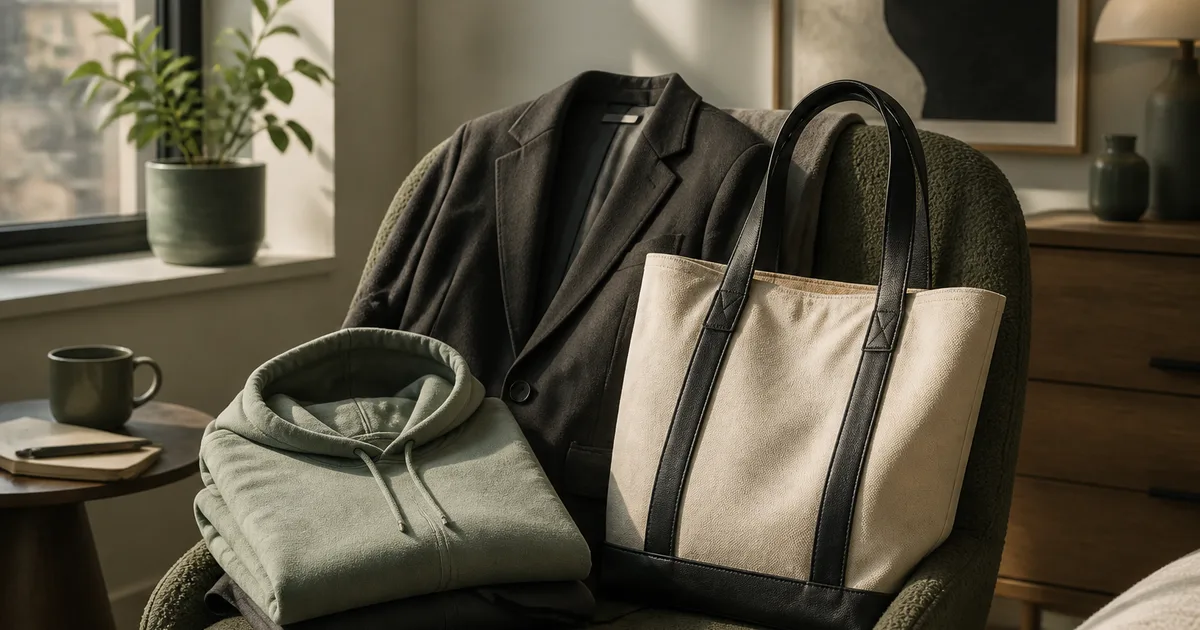
Most autism clothing content is written at children’s eye level. Autistic adults still have to get dressed — for interviews, hospital waiting rooms, dates, and jobs that issue a polyester polo. Many live in a rotation of three “safe” garments and feel, as one research paper put it, trapped in them. This guide is for autistic adults, for parents of teens heading that way, and for therapists who still treat clothing as a paediatric topic. It draws on recent adult research without pretending a UK survey is the whole world. Pair it with the clothing landscape pillar.
Key takeaways
The problem does not end at 18. Tactile hypersensitivity toward clothing remains common. Adults report physical discomfort, narrowed clothing choices, and knock-on effects on appearance satisfaction and self-esteem.
“Safe clothes” save the day and shrink the life. Repeating one hoodie is a rational sensory strategy. It can also block work, ceremony, and the pleasure of looking like yourself.
Uniforms are an employment filter. Campaigns such as Ambitious about Autism’s More Than Just Clothes have reported that a large share of autistic people — on the order of one in three in their survey — decided not to apply for a job because of a mandatory uniform. Fabric policy is labour-market policy.
Children’s adaptive is ahead of adult fashion. Magnets and tagless tees exist more often in kids’ aisles. Adults who want to look like colleagues, not patients, face boutique prices and thin size runs.
Teens are already in this story. School uniform plus social appearance plus first jobs is the rehearsal. Do not wait for a legal birthday to take self-expression and sensory fit seriously.
What the adult research actually says
Knight, Hewitt, and colleagues (2025, open access in Autism; PMC12531387) surveyed 86 autistic adults in the United Kingdom. Higher clothing-related tactile hypersensitivity predicted more appearance dissatisfaction. Dissatisfaction with appearance helped explain the link between that tactile load and lower self-esteem. Appearance awareness also related to self-esteem independently in their models. The sample was majority white, mixed in gender (including non-binary participants), mean age around 32, and not a random population draw. Treat the numbers as a strong qualitative-plus-quantitative signal, not as a universal percentage.
Open comments in that work clustered around negative consequences (pain, itch, anxiety, avoiding events), management strategies (buying multiples of the same item, inspecting clothes in shops, only wearing what already works), and the emotional value of clothing — wanting to look like themselves and feeling frustrated when fabric vetoed the look.
Earlier interview work (Kyriacou and colleagues, 2021) had already documented how specific fabrics changed wellbeing and participation in a small group of autistic adults. Together, the papers support a plain claim: clothing is not a children’s occupational-therapy footnote. It is adult mental health, identity, and access.
What the papers do not show: that a particular brand heals self-esteem, or that every autistic adult is hypersensitive in the same places. Hyposensitivity and seeking exist too. Some adults want weight and compression; some cannot stand cling. The clothing pillar maps those jobs.
The safe-clothes trap
A safe garment is one the nervous system has already classified as non-threat. Buying five of it is intelligent. Washing in rotation is intelligent. The trap is when every other garment is treated as contamination, so the person cannot attend a funeral, a wedding, a lab with a coat requirement, or a shop that is too hot for the hoodie.
Shame makes the trap tighter. Adults who were punished as children for stripping or for “looking sloppy” may hide the rotation and spend money on clothes that hang unworn. Appearance dissatisfaction in Knight’s study is not vanity; it is the gap between the body that must be protected and the person who still wants to be seen.
Practical exits are small. Change one attribute at a time: same cut, slightly different colour; same fibre, slightly smarter collar; a blazer over the holy hoodie if the workplace will accept it. Photograph the care label of winners. When a factory changes the hand of the fabric, the grief is real — plan a search before the last spare dies.
For some people the honest accommodation is remote work, uniform exemption, or a job whose dress code was part of the interview questions. That is not failure to “adult.” It is matching the environment to a nervous system, the same logic as autistic burnout recovery: drop unnecessary costume.
Workwear, uniforms, and interviews
Mandatory uniforms, branded polos, safety boots, hairnets, and “business casual” chinos are where adult clothing meets power. Ambitious about Autism’s campaign framed uniform policy as a reason people do not apply. Even without that statistic, clinicians hear the same story: the job was possible; the shirt was not.
Ask early, in writing, the way families ask schools — see school uniforms for the template. “I can wear a plain polo in the team colour in cotton jersey instead of the supplied polyester, same logo if required as a pin not embroidery.” Occupational health, disability leave law, and union processes differ by country; the sensory sentence is portable.
Interviews are a one-day uniform. A “smart” fabric that guarantees shutdown in the lobby is a bad strategy. Wear the most formal version of already-safe clothes. If the culture punishes that, you have data about the culture.
Safety kit (high-vis, steel toe, flame retardant) is harder. You may need a specialist supplier, extra socks as a barrier, or a role adjustment. Do not fake tolerance of a boot that injures; injuries become “behaviour” and then dismissal.
Healthcare, hospitality, and retail are heavy uniform sectors and also heavy sensory environments (smell, light, standing). Clothing is one lever next to sensory processing and anxiety.
Self-expression, gender, and looking “too autistic”
Clothing is how many people signal gender, subculture, professionalism, and mood. Autistic adults described in the 2025 study the loss of that channel when fabric vetoes the signal. Autistic women and femme people additionally report pressure to perform gendered dress; the masking guide is the wider frame. A scratchy blouse that “looks appropriate” is camouflage with a textile tax.
Gender-affirming garments must pass the same skin test as any other. A binder or a heel that causes shutdown will not be worn, whatever its social meaning. Build from tolerable base layers (underwear, socks, shoes) and add the gender cue in the least painful place — colour, hair, jewellery, a soft overshirt — rather than starting with a costume that fails in twenty minutes.
Looking “not autistic enough” versus “too sloppy for work” is a double bind, not a personal branding failure. Communication prints (diagnosis or need on a T-shirt) remain optional and more fraught for adults in professional spaces than for some families of children; see clothing labels as communication.
What adult retail still does not sell
Soft, office-plausible trousers in a full size range with a flat waistband and no theatrical “adaptive” silhouette. Interview dresses and suits that do not rely on lining scratch and structured canvas. Seasonal coats. Swimwear for communal changing rooms. Wedding options that are not a surprise-itch event. Repeatable SKUs so the five-copy strategy survives a year. Prices that are not boutique.
Magnetic work shirts exist in patches. Seamless adult socks exist in patches. The combination, in a high-street shop in a Russian-speaking city, mostly does not. Adults then do what children do: cut tags, size up, live in merino or jersey, and pay import duty when they can.
This is the gap the children’s market is slowly filling and the adult market has not. If you design products, start here — not with another printed children’s cap, unless that is a separate communication job.
For parents of teens
The safe-hoodie pattern in Year 9 is the adult pattern in miniature. Duplicate now. Practise one “next formal” item on a low-stakes day, not the morning of the exam. Involve the teen in uniform negotiations so they have language for HR later. Do not mock the rotation. Do not throw out the last spare “to force variety.”
First jobs (shop, kitchen, warehouse) are clothing trials. Read the kit list before they accept. Budget for duplicates of whatever they can actually wear.
Common mistakes
“You’re an adult, dress like one.” Adults have nervous systems.
Spending on a capsule wardrobe of unworn smart pieces. Spend on copies of the worn ones, then one adjacent experiment.
Hiding the need from occupational health. Early written ask beats a performance review about “appearance.”
Using alcohol or shutdown as the only way through a dressy event. Change the garment or shorten the event.
Assuming compression or fashion-adaptive Instagram equals adult access. Test on the body.
Practical starting plan (two weeks)
Week one: inventory the actual rotation (not the wardrobe). Photograph labels. Buy one spare of each surviving item if you can.
Week two: pick one context that currently gets refused (office, family event, gym). Design the least-change outfit that could enter that room. Wear it at home for an hour. If it fails, change fibre, not ambition.
FAQ
Is this just preferring comfort, like everyone?
Everyone has preferences. Autistic tactile hypersensitivity, when present, can make the “preference” the difference between attending and not, or between self-esteem and chronic dissatisfaction — that is what Knight’s 2025 sample points to. Magnitude matters.
Should I disclose autism to get a uniform exemption?
Only if the workplace is safer with the word than without. You can sometimes describe the sensory need without a label. Local discrimination law varies. Use a trusted adviser if the job is high stakes.
What if I like looking unusual but nothing unusual feels OK?
That is the trap. Put the unusual in accessories, hair, or a single over-layer that does not sit on the worst skin zones. Or find a maker who will copy a safe cut in a louder cloth — still a copy of a known hand.
Do magnets help adults at work?
When buttons are the delay or the fiddle, yes. When the issue is polyester against the back, no. See adaptive dressing.
Can therapy “fix” clothing sensitivity?
Therapy can reduce anxiety around dressing, build motor skill, and help with the grief of the trap. It cannot honestly promise to delete tactile difference. Environmental fit remains the main tool.
I only care about my child’s clothes. Why read this?
Because the child is an adult in waiting, and because some readers of this site are autistic parents. The gaps they will hit are already visible.
Further reading
Clothing landscape, adaptive dressing, underwear, socks, shoes, school uniforms, masking, autistic burnout, anxiety, sensory processing. Open access: Knight et al., 2025.
Conclusion
Autistic adults were not supposed to disappear from the clothing conversation at the school gate. They still need seams that do not shout, jobs that do not require a hair shirt, and room to look like themselves on a Tuesday. The research is catching up. The shops are not. This week, protect the rotation you have — and ask one institution, in writing, to accept its twin in a fibre you can survive.