
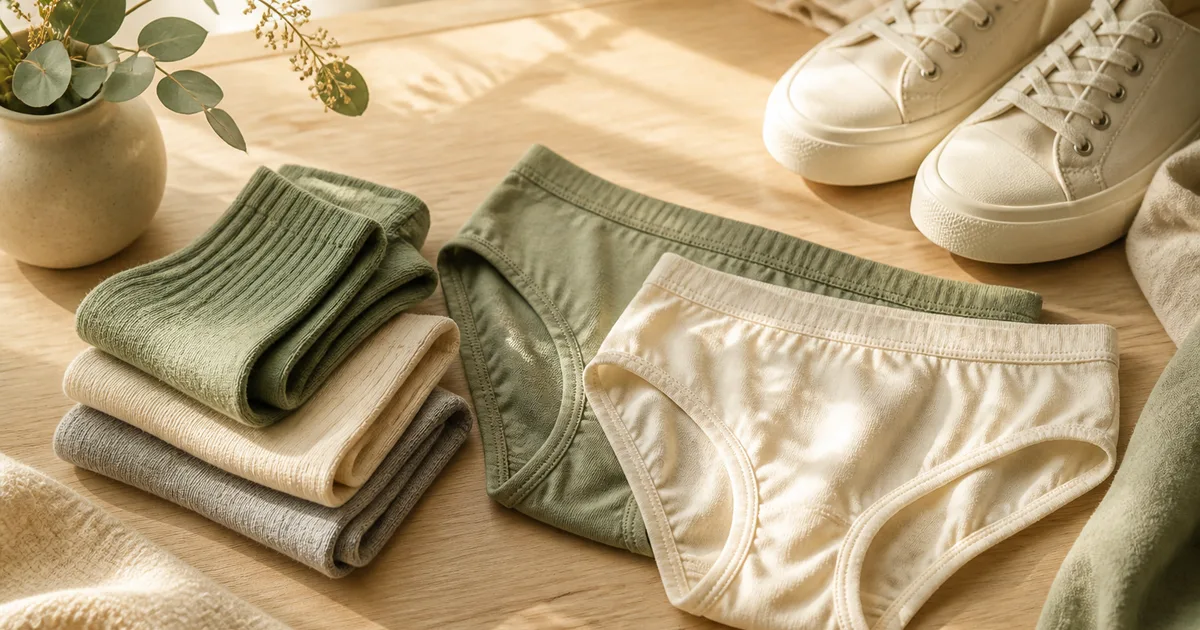
T-shirts get the blog posts. The garments that actually decide whether a child will leave the house are usually socks, underwear, shoes, and whatever they sleep in. These sit on skin for hours, move with every step, and often include the worst construction details in the wardrobe: toe seams, tight elastic, underwires, stiff heels. This guide is the companion to the clothing landscape pillar for that second layer. It is for parents, caregivers, and therapists. It is not a brand ranking.
Key takeaways
Win the base layer first. A perfect jumper over an intolerable sock still fails. Audit socks, pants, vest, and shoes before you spend on outerwear.
Seamless is a real engineering idea, not a slogan. Circular-knit socks and underwear exist because toe seams and gusset edges dominate attention. They are unevenly available and often pricey. Hacks (inside-out, size up, barrier layers) still matter.
Shoes are clothing. Pinch, flex, tongue pressure, and the sound of the sole are tactile and auditory load. Velcro versus laces is motor plus sensory, not only “independence.”
Sleepwear is often the only honest data. If the child can only rest in one fabric, that fabric is a clue for daytime copies — without trapping them in pyjamas as a public identity.
Toilet learning and underwear are one system. A waistband they cannot get down, or a texture they will not tolerate after a nappy, will look like “not ready.” See toilet training.
Why this layer is the real bottleneck
A polo collar is miserable. A sock seam is miserable and repeats with every step. Autistic tactile systems that lock onto detail will lock onto that ridge. Community reports and adult interview studies repeatedly name socks, tags at the waist, and tight clothes among the worst daily textures. Knight and colleagues (2025) heard autistic adults describe limited “safe” garments; socks and close-fitting items appear often in that kind of testimony even when the paper’s focus is appearance and self-esteem.
Factories put the cheapest elastic and the most raised seams in garments nobody photographs. Marketing budgets go to hoodies. Families then wonder why a “sensory-friendly” sweatshirt did not fix the morning. The morning was the sock.
Shoes add bone, tendon, and temperature. A stiff school shoe can feel like a splint. A seam inside the toe box is a sock problem plus leather. Some children refuse shoes because the floor feeling through a thin sole is wrong; others because the shoe removes the floor feeling they need. Both are sensory; they need opposite solutions.
Socks: seams, cuffs, and the myth of “just wear them”
Start with the toe. A conventional sock has a sewn seam across the toes. Many people never notice it. Many autistic people cannot stop noticing it. Seamless or “almost seamless” knitting, or a hand-linked toe, is the actual product category worth seeking. Turning ordinary socks inside out moves the ridge off the top of the toes — ugly in a sandal, often fine in a shoe.
Cuffs are the second fight. A tight rib that leaves a dent in the shin is continuous compression the child did not choose. A loose cuff that puddles in the shoe bunches and rubs. Size, fibre, and how much the cuff recovers after wash all matter. Cotton socks that bag after two washes become a new texture.
Length matters more than parents expect. Ankle socks can feel like a ring that should not be there. Knee socks add a line below the knee. Some children need the sock to disappear under a long trouser; others cannot stand anything on the calf. PE socks are often the worst fibre in the drawer.
If the child will only wear one pair, buy every identical pair you can find and accept that the factory will discontinue them. Keep one unworn spare as a template for matching. This is the same “safe clothes” logic adults describe; it is not a toddler quirk.
School socks are a uniform issue as much as a textile one. A black seamless sock in the required length is often an easier written exception than a different polo. See school uniforms.
Underwear and bras: elastic, labels, and the nappy transition
Waistbands do the damage trousers get blamed for. A rolled, ruffled, or picot elastic on the navel is the irritant Jordaan’s uniform research heard from parents who then bought larger, softer pants as a shield. That hack still works: the underwear becomes the true waistband, and the trousers sit on top of fabric instead of skin.
Leg openings cut or leave red rings. Seams at the gusset sit in a place most people are taught not to talk about — which is why the child may undress at school or refuse toilets rather than name the problem. Check the garment on the body, not on the hanger.
Labels at the back waist are tags by another name. Cut them. Printed size dots are better.
The nappy-to-pants jump is sensory as well as continence. A nappy is thick, warm, and familiar. Thin cotton pants are a new climate and a new waistband. Some children need a staged thickness (trainer pants) or a familiar character print on a tolerable cut — print as a bridge, not as the whole solution. If pulling pants down is motor-hard, choose a looser waist for learning even if you later tighten for school. The toilet training guide and this paragraph should be read together: dry pants you cannot tolerate will not stay on.
Bras, binded vests, and first underwear for puberty are a cliff. Underwires, hook-and-eye closures, and decorative lace are concentrated light touch on a changing chest. Soft bralettes, stretch crop tops, or seamless wireless styles are the usual experiments. Some autistic teens would rather a sports-style layer; some cannot stand compression on the ribcage at all. Let the wearer veto. Gender-affirming clothing needs the same sensory rules: the right gender signal on the wrong fabric will still be torn off.
Period products add another texture stack (see also medical and hygiene load in the sensory guide). Underwear with a tolerable pad pocket, or a preferred pant plus a chosen product, is worth the experiment before anyone lectures about “growing up.”
Shoes: pinch, tongues, fasteners, and the floor
Fit is not only millimetres. A shoe can be the right length and still press the little toe, the nail, or the instep. Autistic children may not localise that pain; they may simply refuse to walk. Have feet measured, then watch the child stand and walk for ten minutes, not ten seconds in the shop.
Tongues and laces sit on the top of the foot — another high-detail zone. Thick tongues feel like a lump; thin tongues wrinkle. Velcro is faster and often louder (a sensory cost) and can feel scratchy if the hook side kisses skin. Magnets and large pulls exist in some adaptive trainers. Laces are a motor curriculum; they are not morally superior if they make the child late and distressed every day.
Heels, stiff leather school shoes, and formal shoes are where dignity and pain collide for older children. A black trainer the school will accept may be the whole accommodation. Indoor versus outdoor shoes, if the family uses that split, should follow the same home versus outside logic so “shoes on” does not always mean “we are leaving this second.”
Barefoot preference is information. Some children need more ground feel (thin flexible soles). Some need less (cushioned, enclosed). Do not assume “sensory = always barefoot” or “sensory = always tight.”
Waterproof boots and winter lining are heat-and-itch bombs. Test them at home before a snow day.
Sleepwear and the “only pyjamas” wardrobe
Many autistic people have a garment that tells the truth: the thing they can sleep in. Jersey with a washed-soft hand, no cuff, no collar. That item is a template. Copy its fibre and cut into daytime pieces instead of expanding the pyjama identity into the street unless the child needs that and the context allows it.
Weighted blankets and sleep sacks are adjacent tools, not clothes. Safety and the right to remove them belong in the sensory processing guide. A zip-up sleep suit that the child cannot undo is restraint if used to stop undressing. Find a tolerable layer and a room temperature that does not force stripping, rather than zipping the problem closed.
Night sweating and thermoregulation wreck sleepwear that was fine in October. Keep a hot-weather and a cold-weather safe set. Sleep debt then makes next day’s clothing battles worse — see sleep problems.
What the market still fails to offer
Seamless kids’ socks exist in pockets of the US and specialist webshops. Adult seamless options, wide calf, plus size, and cheap supermarket versions that stay the same next year are thinner. Bras that are both sensory-tolerable and available in a full size range remain a boutique problem. School-legal black shoes that flex like trainers are a negotiation, not a product line, in most towns.
In Russian-speaking retail you will mostly hunt among ordinary children’s socks labelled “without a seam” (verify with a finger inside the toe), indoor sandals, and jersey underwear. Importing a year’s supply of one winning sock SKU is a rational household strategy, not excess.
How to test without filling the bin
Buy one. Wash how you actually wash. The child tries it at home, not on the way to the bus. Ten minutes of walking, sitting, and a toilet trip — underwear that cannot come down fast enough fails even if it feels fine standing still.
Keep a small “no” box so you do not gaslight yourself next season into rebuying the same cuff. Photograph winners’ labels.
If eczema or fungal itch is in play, treat skin and laundry detergent as part of the clothing plan. Sensory and dermatology overlap; neither specialist should dismiss the other.
Common mistakes
Starting with a branded hoodie. Start with the sock.
Forcing seam exposure as “desensitisation.” A toe seam for a whole school day is not a gentle ladder.
One size of underwear for home and school. You may need a looser pant for toilets and a smoother one for sitting, or a barrier layer.
Shaming bare feet or pyjamas at home. Home is allowed to be the place the nervous system clocks off. Public dress can be a separate skill. See daily life at home.
Ignoring growth. Last month’s winner becomes this month’s tourniquet.
Practical starting plan (two weeks)
Week one: pick socks or pants, not both. Find one wearable pair. Duplicate it. Track morning time.
Week two: shoes or sleepwear, whichever currently blocks leaving or sleeping. One change. If school is the driver, put the winning sock into the uniform negotiation as a written substitution.
FAQ
Are seamless socks worth the price?
If the child currently cannot keep any sock on, yes — even two pairs. If ordinary inside-out cotton works, spend the money on duplicates of that.
My child refuses all underwear. What now?
Check waistband, label, and humidity. Try a longer boxer or a soft short as a bridge. Rule out rash. Do not frame it as moral. Some people live in lined shorts; that can be a valid home solution while you search.
Can we skip socks in shoes?
Sometimes, with the right shoe lining. Sweat and rubbing can worsen. Test at home. Schools may object; that becomes a uniform conversation.
What about compression socks?
Only if the wearer wants that pressure. Unwanted compression is another tight cuff. Not a stealth therapy.
How do adaptive magnetic shoes fit in?
They help when laces are the delay. They do not fix a narrow toe box. See adaptive dressing.
Is it OK that teens still want the same cartoon underwear?
If the cut is tolerable, yes. Public appearance can be negotiated separately from the layer nobody sees. Shame is a worse teacher than a cartoon.
What if shoes come off in public?
Safety first. A second, more tolerable pair in the bag beats a lecture on the pavement. Look at fit, heat, and whether “shoes” still secretly mean “we are staying out too long.”
Further reading
Clothing landscape, school uniforms, toilet training, staying dressed at home, sensory processing, sleep, daily life at home, adults and workwear.
Conclusion
The glamorous part of “autism clothing” is a hoodie with a story. The part that changes attendance is a sock without a ridge and a waistband that does not saw. Treat those pieces as medical devices for a day: test, duplicate, document, replace on growth. This week, fix one contact surface that moves with every step.