
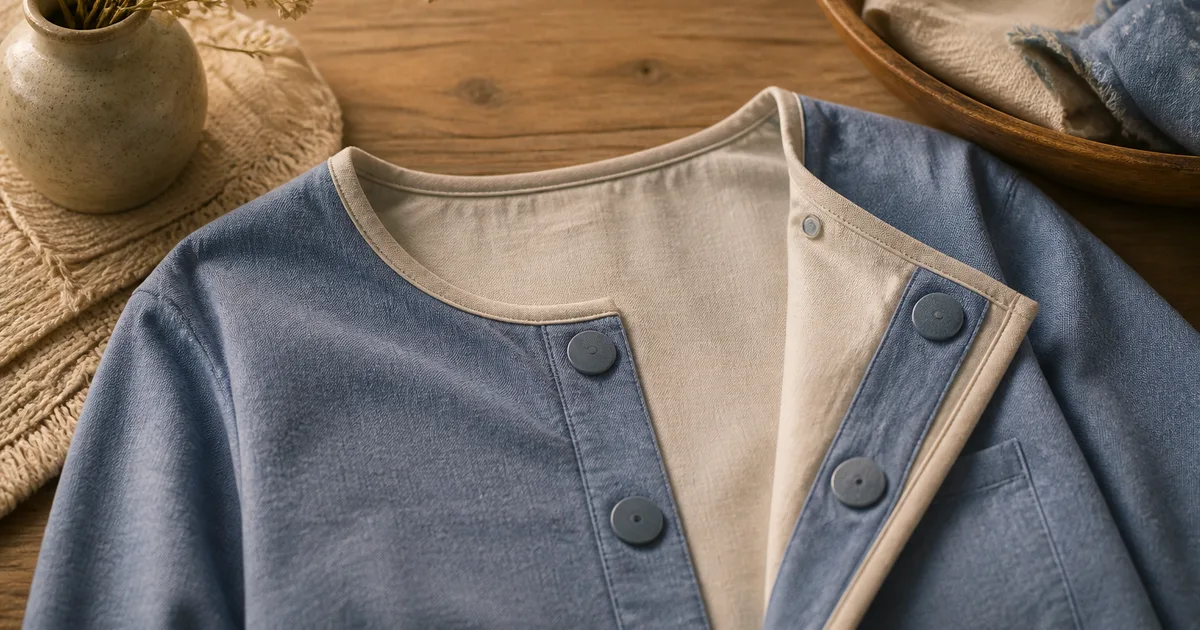
“Adaptive clothing” in a search bar usually means easier dressing: magnets instead of buttons, wide necks, side zips, open backs for a seated person. That industry grew around physical disability, ageing, and hospital care. Autistic people borrow from it whenever mornings die on a button or a tight turtleneck — and they get hurt by it whenever a Velcro tab is louder and scratchier than the button it replaced. This guide separates mobility-adaptive design from sensory-first clothing, then offers a practical dressing plan for families and therapists. Read it with the clothing landscape pillar.
Key takeaways
Two jobs, often one hangtag. Adaptive = get the garment on. Sensory-friendly = live in it for hours. Buy for the job you actually have. Many autistic people need both, in different items.
Magnets and wide necks are brilliant for motor and anxiety-about-stuck. They are irrelevant if the only problem is a toe seam. Do not import a magnetic shirt to fix a sock.
Caregiver speed can fight wearer comfort. Open-back tops and noisy hook-and-loop help the adult and can degrade the child’s morning. High-support families must name both users.
Independence goals should not require pain. “Dresses self in elastic trousers” is a skill. “Tolerates denim to please the programme” is endurance. Split them.
Dignity includes looking like peers. Institutional cuts that scream “hospital” cost teenagers social safety. Hidden magnets under ordinary-looking buttons are the design pattern worth copying.
What “adaptive” was built for
Rehabilitation and ageing fashion asked: how does a person with limited shoulder range, a prosthesis, a tremor, or a wheelchair get dressed without standing or without fine pincer grasp? Answers included magnetic plackets that look like buttons (Tommy Adaptive is the mass-market example many families have seen), hook-and-loop behind a false button row, trousers with side openings to slide over braces, shirts that open fully so they drape on rather than pull over the head, and one-handed zip pulls.
Those answers help autistic people when praxis, tone, joint laxity, or panic about the head-hole is the bottleneck. They also help when a parent is dressing a child who cannot yet sequence sleeves, or an adult with high support needs who is being dressed in bed or a chair.
They do not automatically help tactile defensiveness. A magnetic placket is a row of hard discs. Hook-and-loop is a scratch soundtrack. An open-back shirt may flap and sit wrong on the scapulae. Silverts-style garments designed for nursing homes can be lifesaving for access and still look and feel like medical equipment.
Sensory-first versus mobility-first: a working comparison
Think in pairs, not in brand loyalty.
A seamless, tagless cotton tee with a normal neck solves hours of itch and solves nothing about buttons. A magnetic oxford shirt solves buttons and may still have a stiff collar and a sewn-in tag. A side-zip trouser solves standing balance and may add a zip tape along the thigh that feels like a ruler. Compression leggings solve (for some) proprioception and can make toileting slower — a motor and dignity cost.
When you shop or sew, write the failure mode on a sticky note: “cannot get over head,” “cannot do buttons before the bus,” “cannot stand the waistband once on,” “cannot be dressed by someone else without distress.” Only then pick a mechanism.
Therapists writing ABA or OT goals should use the same sticky note. Mixing “puts shirt on unassisted” with “keeps itchy shirt on for 15 minutes” trains the child that independence is paid in pain. Assent-based teaching uses a garment the child can already tolerate, then teaches the motor sequence. The sensory processing guide makes the same point for clinic rooms; dressing is just a smaller room.
Closures in practice: magnets, Velcro, zips, elastic
Magnets. Quiet, fast, look typical when hidden. Risks: pinch, interference with some medical devices (ask the clinician if there is a pump, stimulator, or similar), a hard lump against the chest, and laundry damage if they clap together. Good for school shirts and adult work shirts when the fibre is already acceptable.
Hook-and-loop. Forgiving of aim, harsh on skin and ears. Cover the hook side so it never kisses a wrist. Some children love the predictability; some startle at the tear sound every time. Not a default “autism fastener.”
Zips. Large pulls and two-way zips help. Metal teeth at the throat do not. A zip garage (the little fold of cloth at the top) prevents chin stab. Side zips for seated dressing are a gift for some bodies and a ridge for others.
Elastic waists and pull-on everything. The unsung adaptive technology. Most families should exhaust pull-on trousers and tees before importing magnets. Elastic still has a sensory profile — see underwear and waistbands.
Snaps and big buttons. Better than tiny shirt buttons; still a fine-motor tax. Use only if the person enjoys the click.
Shoes follow the same map: Velcro, magnets, slip-ons, versus laces as a separate curriculum. Do not hold recess hostage to shoelace ideology.
High support needs: two users, one garment
When a caregiver dresses someone who cannot do it themselves, time, back health, and consent collide. Open-back, wrap, or side-open designs reduce lifting. They can also expose skin, look clinical, and deny the wearer control.
Minimum ethics: explain what you are doing, pause if there is distress that is not only “I hate mornings,” keep genitals and chest covered as much as the task allows, and prefer garments the person would recognise as theirs, not as clinic stock. If the wearer has a yes/no switch, picture cards, or a gaze — use it for colour and for “this shirt versus that shirt,” even when they cannot complete the motor act. Visual sequences for dressing belong with visual schedules.
Families who also fight stripping after dressing are not failing adaptive design; they may be hitting sensory or “clothes mean we leave” associations. That is staying dressed at home, not a reason to zip someone into a garment they cannot escape.
Toileting access is part of dressing design. A stylish adaptive jumpsuit that needs two adults to remove is a continence disaster. Rank toilet speed next to morning speed. See toilet training.
Teaching dressing as a skill
Break the chain: lay out, identify front, head hole, one sleeve, other sleeve, down over trunk, adjust. Photograph each step on their winning garment. Practise when there is no bus. Use backward chaining (adult does all but the last step) if initiation is the wall.
Do not add a new fibre during skill teaching. Motor learning on a hated texture is two programmes fighting.
Occupational therapy can assess shoulder range, bilateral coordination, and sitting balance, then recommend a fastener. Bring the actual clothes. A clinic that only has plastic dressing frames is practising a different sport.
If anxiety is “I will get stuck and die in this neck,” practise with a wide-neck garment and a helper who will not joke about pulling it over the face. Panic here is not cute. It is interoception plus memory of a previous trap.
What is still missing in adaptive–sensory overlap
Hidden magnets in soft jersey school polos at supermarket prices, in children’s and adult plus sizes, in colours that match local uniforms — that product barely exists outside a few Western lines. Seated-dressing design that looks like streetwear for autistic adults who use wheelchairs and hate tags is a niche of a niche. Quiet fasteners (magnets, large snaps) in winter coats and swimwear are rare. Dual-user garments that are fast for a caregiver and comfortable for a tactile-defensive wearer are mostly custom sew.
Russian-speaking families will mostly use pull-on knits, sewn-in magnet sets from craft shops (test pinch and wash), and tailors who can replace a button placket. That is valid adaptive practice. It does not require a US catalogue.
Common mistakes
Buying “Tommy-style” for a seam problem. Wrong job.
Using Velcro because it looks disabled-friendly. Test the sound and the hook side.
Open-back as a first resort on a teenager who can pull on a tee. Dignity first; speed second unless safety requires otherwise.
Goals that combine motor and grit. Split them.
Leaving someone in a magnetic shirt in an MRI-adjacent or device context without checking. Ask the clinician.
Practical starting plan (two weeks)
Week one: write the failure mode. If it is “over the head” or “buttons,” try one wide-neck or pull-on item you already own. If it is “once on it hurts,” stop shopping adaptive and go to base layers.
Week two: if motor is confirmed, add one mechanism (larger pulls, or a tailor-applied magnet placket on a shirt the person already tolerates). Practise the chain without time pressure. Do not replace the whole wardrobe.
FAQ
Is adaptive clothing only for physical disability?
No. Autistic motor and anxiety profiles overlap with those designs. The marketing is still biased toward other populations, so you have to translate.
Are magnets safe around tablets and cards?
Usually fine at clothing distance; keep spare bank cards out of a magnetic placket pocket. Medical implants need a clinician’s word.
Can we sew magnets into ordinary clothes?
Yes, with sew-in magnetic snaps, aligned so they do not pinch skin, and tested in the wash. If you are not a confident sewist, a tailor is cheaper than a ruined shirt and a bruised chest.
My child can dress but takes 40 minutes. Is that sensory or motor?
Often both, plus executive function. Time the steps. If most minutes are spent grimacing at the sock, it is not a button problem. If most minutes are lining up a zip, teach the zip or change the zip.
Should ABA programmes include dressing?
They can, on tolerated clothes, with assent, without using unfinished dressing as a punisher. Skill is not compliance under itch.
What about one-piece suits for elopement or stripping in public?
Safety can require them in specific, time-limited situations. They are still restrictive. Pair with a search for a tolerable two-piece and with the function of the stripping (heat, itch, toilet, “I want home”). A suit is not a personality.
Further reading
Clothing landscape, underwear, socks, shoes, school uniforms, staying dressed at home, visual schedules, toilet training, sensory processing, adults and workwear.
Conclusion
Adaptive fashion already knows how to hide a magnet under a button. Sensory design already knows how to hide a seam. The missing product is both, in a cut a teenager would wear, at a price a family can repeat next year. Until shops catch up, name the failure mode, steal one mechanism, and refuse to train independence on a garment that hurts. This week, change the fastener or the fibre — not both — on the one item that makes you late.