
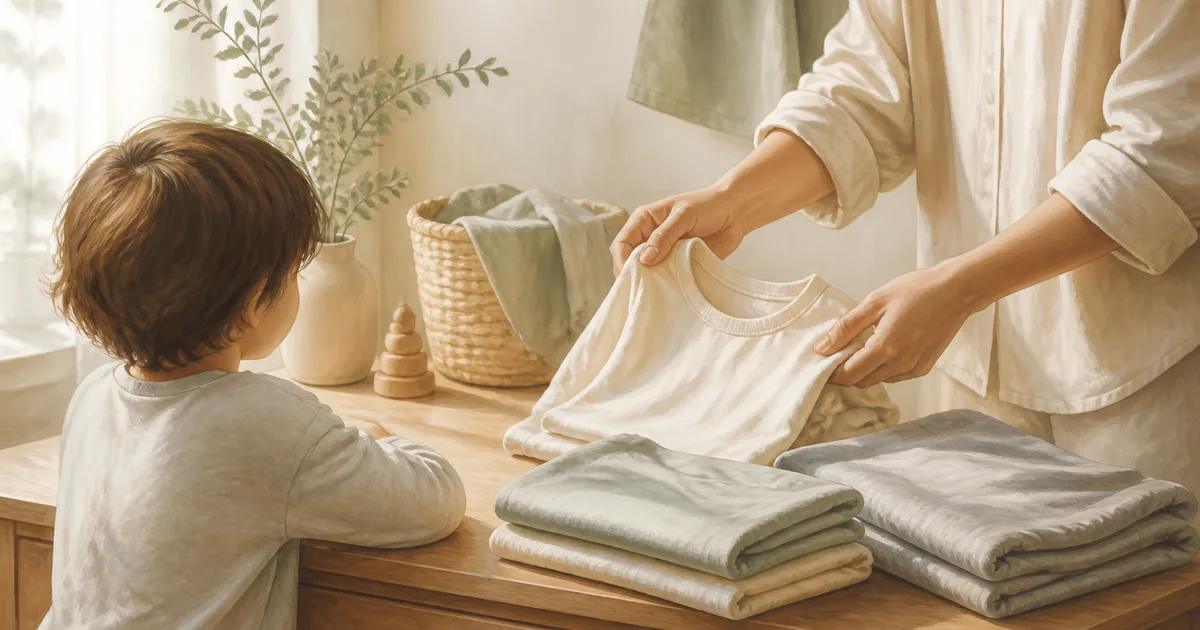
Clothing is not a side issue in autism. For many children, teens, and adults it is the first sensory load of the day and the last one still pressing at bedtime. This guide maps what the world has actually built — tagless knits, magnetic closures, compression layers, school-uniform hacks, communication prints — and what remains badly missing, especially outside a handful of US, UK, and Australian shops. It is for parents, caregivers, and therapists. It is not a shopping catalogue, not a diagnosis, and not permission to force “tolerance” of pain.
Key takeaways
Fabric on skin is a nervous-system problem. Tags, seams, elastic, heat, and scratchy fibres can feel like injury. Refusal is often information, not defiance. Pair this map with the sensory processing guide.
Two industries got mixed in one aisle. “Adaptive” clothing often means easier dressing for limited mobility. “Sensory-friendly” clothing means less tactile pain. A magnetic shirt can still feel awful. A seamless tee can still be impossible to pull over a stiff shoulder.
Mass-market lines exist, but they are geographically thin. Tommy Adaptive, Target Cat & Jack Adaptive, SmartKnit-style seamless socks, and UK sensory school-uniform options illustrate categories. They are not a global standard, and they rarely reach Russian-speaking retail at a fair price.
The worst gaps are not T-shirts. Underwear, socks, bras, shoes, winter coats, swimwear, workwear, and adult sizes that look like peers — not medical garments — are where families and autistic adults still improvise every week.
Buy less, audit more. One tolerable school outfit rotation beats a wardrobe of “nice” clothes that never leave the drawer. Ordinary clothes can be hacked: cut tags, size up, wear inside out, swap elastic. Specialty brands help when the hack fails.
Why clothing is a nervous-system problem, not pickiness
Getting dressed looks simple from the outside: choose, pull on, go. For an autistic body it can stack several costs at once. A neckline scrapes. A sock seam sits on the toe like a ridge. A waistband ruffles against the navel. Indoor heating plus polyester means the child is already overheated before breakfast. Adults call this “being difficult about clothes.” The child is trying to stop a stimulus they cannot filter.
Qualitative work with autistic adults has made the same point in first person. In interviews about fabrics (Kyriacou and colleagues, Journal of Autism and Developmental Disorders, 2021), participants described how some textiles changed mood, concentration, and willingness to leave the house. Soft, flexible cloth was repeatedly preferred; abrasive weaves, tags, and certain synthetics were not. The sample was small — ten adults — so it is a map of experience, not a ranking of fibres for every autistic person. What it does support is taking fabric choice as seriously as noise or lighting.
A later mixed-methods study of 86 autistic adults in the United Kingdom (Knight and colleagues, 2025, open access in Autism) found that higher clothing-related tactile hypersensitivity predicted more appearance dissatisfaction, and that this dissatisfaction helped explain lower self-esteem. People described being “trapped” in a handful of safe garments: physically better, socially narrower. That paper is about adults, but parents of teens will recognise the bind: the hoodie that feels safe may be the hoodie a school or workplace forbids.
Families feel the cost even when the child cannot name it. Focus groups with mothers and occupational therapists (South African occupational-therapy research, 2025, building on earlier uniform studies) described morning battles, delayed school starts, and the way one intolerable shirt can colour a whole household’s day. Sensory-friendly options were often expensive, hard to find, or aesthetically “other.” When they were missing, children still had to get dressed. Meltdowns followed the fabric, not a moral failure in the parent.
Temperature and interoception add a second layer. Some autistic people do not notice they are too hot until they strip. Others need deep pressure from a snug layer to feel where their body is. The same child can refuse a coat outdoors and cling to a heavy hoodie indoors. That is not contradiction; it is two different problems — thermoregulation and proprioception — sharing one wardrobe. Home routines that separate “house clothes” from “going-out clothes” often help; see staying dressed at home and the clothing section of daily life at home.
A map of what already exists
The useful way to look at “autism clothing” is not a list of brand names that will be outdated next season. It is a set of design jobs. Different products solve different jobs. One garment rarely solves all of them.
Seamless, tagless, and flat-seam construction
The job: remove the small, sharp, or rubbing details that dominate attention. Printed or heat-transfer care labels instead of sewn-in tags. Flatlock or bonded seams instead of bulky overlock ridges. Truly seamless knits for socks and underwear, where a toe seam can ruin a whole school day.
This is the most widely copied idea. Mainstream children’s lines in the United States (for example Target’s Cat & Jack Adaptive) have used tagless cotton blends and flatter seams on basics. Specialist knitters such as SmartKnit built a reputation on seamless socks and underlayers. The engineering is not mysterious: circular knitting and careful finishing. The barrier is retail habit. Ordinary shops still sew a cardboard-stiff tag into the neck because that is how factories ship garments.
Magnetic, hidden, and easy closures
The job: independence or faster caregiver dressing when buttons, metal zips, and tight necklines exceed motor skill, joint range, or patience. Tommy Adaptive popularised hidden magnets that look like ordinary buttons. Other lines use hook-and-loop behind a placket, extra-wide necks, or side zips so a seated person can dress without standing.
These features come from a broader adaptive-fashion movement that also serves wheelchair users, people with prostheses, and older adults. That overlap is a gift when motor and sensory needs coincide. It is a trap when a Velcro tab feels worse than a button, or when a magnet plate is a hard lump against the sternum. Closures are covered in depth in adaptive clothing and dressing.
Compression and deep-pressure layers
The job: some people seek firm, even pressure to feel organised in their body. Sensory-oriented brands sell compression tees, vests, and “regulation” hoodies. Occupational therapists have used lycra underlayers for years with mixed, mostly low-quality evidence.
Compression is not a treatment for autism. It is a tool that a person may like, dislike, or like only on some days. Never use it as restraint, never leave a child unable to remove it, and do not treat “tighter” as “more therapeutic.” Weighted garments raise the same safety questions as weighted blankets: appropriate mass, supervision, and the right to take it off. See the compression section below.
School uniforms that look typical but feel softer
The job: pass a dress code without spending the day in pain. UK retailers (including adaptive or sensory-friendly schoolwear from large high-street names) have sold polo shirts without scratchy collars, trousers with softer waistbands, and jumpers in regulation colours with kinder fabric. The look is “same as classmates.” The construction is not.
Where no such line exists — most of the world, including most Russian-speaking schools — families still do the same job with substitutions, negotiations, and ordinary clothes in the right colour. That practical fight is the subject of school uniforms and sensory needs, and it sits inside the broader school support guide.
Communication prints and safety messages
The job: when speech is unreliable in crowds, a short phrase on a cap or T-shirt can shift a stranger from judgment to patience. This is optional, never a duty, and some families dislike being “labelled” in public. NeuroDifferent’s planned clothing line sits in this category. The ethics and wording belong in labels on clothing as communication, not in a sensory-fabric shopping list.
Smart textiles and wearables (a different industry)
Heart-rate shirts, stress-sensing bands, and hoodies with sound-dampening hoods are sometimes marketed next to sensory clothing. They answer a different question: can the garment measure or buffer the environment? A quiet hood may help in a supermarket. A wearable that flags arousal during a behaviour session is a research or clinical tool, not a substitute for a tolerable sock.
Keep the categories separate in your head. Comfort against the skin is still the unsolved daily problem. Gadgets on top of an intolerable base layer will not fix the morning.
Sensory construction: tags, seams, fabric hand, and heat
Four construction details cause most of the wars. They are cheap to change in a factory and expensive to live with when they are wrong.
Tags. A sewn-in care label at the neck or waist is a small rectangle of stiff, often synthetic ribbon. Many autistic people describe it as scratching, stabbing, or “always there.” Cutting it out is the oldest hack and still the first one to try. Printed labels and tear-away tags exist because this complaint is so common it reached mass retail.
Seams. A sock toe seam, a side-body overlock, or a raised shoulder join can feel like a cord under the skin. Seamless knitting removes the join. Flatlock stitching makes the join lower. Wearing a garment inside out moves the ridge away from the skin — inelegant, free, and widely used.
Fabric hand. “Hand” is the textile word for how cloth feels when touched. Soft jersey, some cotton-modal blends, and certain bamboo viscose knits are frequently reported as easier. Coarse wool, stiff denim, hessian-like weaves, and scratchy polyester school polos are frequent villains. There is no universal fibre. One child lives in cotton; another finds washed cotton clingy and prefers a slicker knit. Kyriacou’s adult interviews again: preference is personal, but softness and flexibility recur.
Heat and moisture. Autistic thermoregulation is often uneven. A “warm enough” coat for the parent is a furnace for the child. Synthetic PE kits that do not breathe turn a lesson into panic. Merino and technical wicking fabrics help some people and itch others. The practical test is the child’s body after twenty minutes, not the weather app.
Collars, cuffs, embroidery, and screen-print plastisol sit on top of those four. A polo collar that stands off the neck, a glitter print that flakes, or a rubberised logo over the heart can undo an otherwise decent shirt. School-uniform research (Jordaan and colleagues, Clothing and Textiles Research Journal, 2023) found waistband type and position — especially ruffled elastic over the navel — among the most reported irritants, alongside fabric and construction. Mothers in that work described buying larger underwear as a barrier layer so the waistband would not sit on bare skin.
If you change only one thing this month, change the layer against the skin. Outer style can wait. The underwear, socks, shoes, and sleepwear guide is written for that layer.
Adaptive closures and dressing independence
Buttons, metal zippers, and tight turtlenecks demand fine motor skill, bilateral coordination, and a willingness to tolerate fiddly light touch at the throat. Autistic children may have all, some, or none of those on a given morning. Motor planning differences, low tone, and anxiety about “getting stuck” in a neckhole are common and under-discussed next to sensory language.
Adaptive fashion borrowed solutions from rehabilitation: magnets under a false button, oversized pulls, open-back tops for seated dressing, trousers that slide over braces. For a family whose main problem is getting the shirt on before the bus, these are gold. For a family whose main problem is the shirt already on feels like grit, they may add bulk without relief.
Dignity matters as much as speed. Clothing designed only for caregiver access can look institutional. Teenagers notice. Adults notice more. The design goal worth defending is a garment the person can put on themselves, that looks like what peers wear, and that does not hurt. When those three collide, rank them with the person — not with the catalogue photo.
Therapists writing dressing goals should split the target. “Tolerates denim for 20 minutes” is a sensory endurance goal and often the wrong one. “Puts on elastic-waist trousers with a visual sequence” is a skill. Mixing them into one compliance programme teaches the child that the price of independence is pain. Assent-based practice belongs here as much as in the clinic: see how ABA can respect sensory needs in the sensory pillar, and the dressing companion adaptive clothing and dressing.
Compression, weighted, and “regulation” garments
Marketing in this corner is loud. Compression shirts are sold as calming, focusing, or even as a stand-in for occupational therapy. Weighted vests appear in classroom supply lists. Hoodies with built-in fidgets and sound-reducing hoods blur comfort clothing with a sensory toolkit.
What research can currently say is modest. Deep pressure is a real sensory preference for some autistic people, consistent with seeking proprioceptive input. Formal trials of weighted vests and compression garments for classroom behaviour have mixed and often weak results; effects that show up on a rating scale may not show up in the child’s own report of comfort. Sample sizes are frequently small. Protocols differ. “It worked for us” is valid family data and still not a protocol for every child.
Use a simple rule. The wearer should be able to put the garment on and take it off, or clearly request removal. It should not restrict breathing, digestion, or movement. It should not be used to keep a child in a chair. If the child only “does well” while compressed and falls apart when the vest comes off, you have a dependency on an external regulator — sometimes useful as a bridge, never as the whole plan.
Weighted products need extra caution with young children and anyone who cannot remove the item. Follow weight guidance from a clinician who has seen the child, not from social media. The same ethics as weighted blankets in the sensory guide: tool, not restraint.
Some people need the opposite of compression: zero cling, oversized cuts, no waistband. Selling one “autism body” — always seeking pressure — erases half the population.
Communication clothing: a different job
A cap that reads “I need more time” will not soften a sock seam. It can, in a noisy airport or a supermarket queue, give bystanders a true sentence before they invent a rude one. For some non-speaking or situationally speaking children, that is safety as well as courtesy.
It remains a family choice. Some autistic teens would rather melt down in private than wear a diagnosis on their chest. Others want the words. Do not treat printed messages as a substitute for an environment that hurts less, and do not treat refusal of messages as denial. The dedicated article is labels on a child’s clothing. NeuroDifferent’s own line, when it ships, belongs in that optional toolkit — not as a requirement to be a “good” autism family.
What is still badly missing
This is the part of the map most brand roundups skip.
Geography and price. Adaptive and sensory lines cluster in the United States, the United Kingdom, and parts of Australia and Western Europe. Shipping, duties, and sizing charts make them a luxury import elsewhere. In Russian-speaking retail, families mostly raid ordinary children’s shops, cut tags, and hope. “What exists in the world” is not the same as “what exists on your street.”
The layer against the skin. Seamless socks and tagless tees get the press. Underwear with a tolerable waistband, bras that do not dig or itch, vests for winter, and shoes that neither squeeze nor slip are harder. Many autistic adults in Knight’s 2025 study and in community reports name socks and tight clothes among the worst daily fights. The commercial energy still goes to visible outerwear.
Adult fashion that looks like fashion. Children’s adaptive is further along than adult. Autistic adults who want to look like colleagues, not like patients, face a thin choice: repeat the same three safe items, or pay boutique prices for small labels that may not stock their size. Formalwear, wedding outfits, and interview clothes are almost an afterthought. The adults, workwear, and self-expression guide takes that gap seriously.
Uniforms as a civil right issue. Ambitious about Autism’s More Than Just Clothes campaign reported that a large share of autistic people — on the order of one in three in their survey — had decided not to apply for a job because of a mandatory uniform. That is not a fabric preference. It is employment filtered by polyester. Schools do a quieter version of the same filter every Monday.
Seasonal and “special” clothes. Winter coats, rain shells, swimwear, sports kits, and party clothes are where sensory design usually stops. A child who can do a cotton tee in July may be unable to leave the house in January. Families then face a false choice between frostbite and a meltdown in the hallway.
The caregiver–wearer conflict. Open-back, velcro-heavy garments speed dressing for a supporting adult and can feel like sandpaper plus noise to the wearer. High-support families need both: dignity and a morning that ends before the bus. Few products are designed with that dual user in mind.
Evidence. There is almost no high-quality trial literature that compares clothing designs on participation outcomes (school attendance, time to get out the door, self-reported comfort). Textile and occupational-therapy studies are mostly qualitative or small. That does not make families’ observations untrue. It does mean “OT-recommended” on a product page is often marketing.
Durability versus softness. The nicest jersey pills and blows out at the knee. Families who finally find a wearable item buy five of it, then watch the factory change the fabric. Repeatability — same SKU, same hand, next year — is an unglamorous missing feature.
Plus sizes, petite sizes, and mixed motor-sensory bodies. Adaptive racks often assume one body story. Autistic people who are plus-size, very small, or who combine hypermobility, a feeding tube, or a wheelchair with tactile defensiveness fall through.
How to choose without a US or UK shop
Start with a day audit, not a brand. Walk from wake-up to lights-out and write the three garments that cost the most (often socks, waistband, coat) and the three that already work. Keep the winners. Photograph the care label if you can find a repeat purchase.
Hack ordinary clothes before importing specialty gear.
Cut or unpick tags. Turn shirts inside out. Size up so seams and waistbands sit in a less sensitive place — a strategy parents in uniform studies already use. Choose pull-on trousers over zips. Prefer jersey to woven cotton for the base layer. Wash new clothes until they soften; some children need that ritual before a first wear. Keep a duplicate of every winning item.
For school, negotiate the item, not the whole code: same colour polo in a softer knit; trousers without a ruffled elastic; trainers instead of stiff shoes if motor or sensory need is documented. Put it in writing. Pair clothing with the rest of the sensory day — lunch noise and PE changing rooms will still spend the budget even in a perfect shirt.
When an occupational therapist is involved, ask for a clothing and dressing assessment that names fabrics and fasteners, not only a “sensory diet” worksheet. Bring the actual hated sock to the session. Clinics that have never looked at the child’s underwear elastic are guessing.
Toilet learning, bathing, and clothing interact. A child who cannot get trousers down in time is not only a toilet-training problem — see toilet training. A child who strips at the door may be escaping fabric, heat, or the association “clothes mean we leave”; that is the home clothes versus outside clothes problem.
If anxiety or masking is the reason the child “looks fine” in uniform until 4 p.m., clothing is one lever among others. See anxiety, masking, and autistic burnout.
Common mistakes
Forcing a “just get used to it” week. Flooding with an intolerable fabric can create trauma and stronger refusal. Gradual practice, if used at all, needs the child’s assent and an exit.
Buying a whole “autism wardrobe” in one click. Most of it will be wrong. Test one category.
Confusing adaptive with sensory-friendly. Magnets do not cancel seams.
Punishing undressing. The body is solving a problem. Shame adds a second problem. Calm redressing and a better garment work better than lectures.
Ignoring medical itch. Eczema, laundry detergent allergy, and fungal infections masquerade as “sensory.” Check skin.
Using compression to keep a child still. That is restraint with better branding.
Assuming the same outfit works after illness, growth, or a new school. Last term’s winner can fail in a week. Re-audit.
Letting brand names substitute for the child’s report. If they say it hurts, it hurts — even in a garment a blog called the best of 2026.
Practical starting plan (two weeks)
Week one: pick the single worst daily item (often socks or the school polo). Replace or hack only that. Buy two spares of whatever works. Track morning duration and after-school crash for seven days.
Week two: separate home clothes from going-out clothes if undressing at the door is the issue. Write one sentence for school or nursery: which item needs a substitution and why, in sensory language, not “behaviour” language. If nothing moved, look at heat, detergent, and skin before buying a compression vest.
FAQ
Is there one best fabric for autistic children?
No. Soft, flexible knits are a common win, but individuals differ. Cotton, bamboo viscose, modal blends, and some synthetics each have fans and enemies. Test on the body, not on a fibre name.
Should we cut all the tags?
Usually yes, unless the printed ink of a replacement label is worse than the ribbon. Start at the neck and waist.
Are magnetic clothes worth importing?
They are worth it when the bottleneck is buttons, zips, or getting stuck in a neckline. They are not worth it if the only problem is how the cloth feels. Try a local pull-on alternative first.
Can clothing cause meltdowns?
Yes. Continuous tactile pain plus time pressure is a classic stack. Treat the garment as a trigger to change, not only as a behaviour to suppress. See meltdowns.
Is compression clothing evidence-based?
It is under-studied as a standard intervention. Some people clearly prefer it. It is not a cure and should never be forced or used to immobilise.
What if my child will only wear one hoodie?
That is a common “safe clothes” pattern. Protect duplicates, wash in rotation, and expand slowly from a similar hand and cut — not from a leap into denim. Adults describe the same trap; it is not a childish habit.
Do we need a diagnosis on the clothing?
No. Messages are optional. Sensory construction is the daily need; prints are a social tool some families want and others refuse.
How do we handle school when there is no adaptive uniform shop?
Substitute the painful piece in the closest colour, document the sensory reason, and ask for a written exception. Fight one item at a time. Details are in the school uniform guide.
When should we see an occupational therapist about clothes?
When dressing regularly blocks leaving the house, school attendance, hygiene, or safety — or when home hacks have stalled. Bring the actual garments.
Will my child grow out of clothing sensitivity?
Sometimes the list of intolerable items shrinks; sometimes adults still live in the same three fabrics. Adaptation is success. Waiting for them to “toughen up” is not a plan.
Further reading
On this site: sensory processing, daily life at home, staying dressed at home, clothing labels as communication, school uniforms, underwear, socks, and shoes, adaptive dressing, adults and workwear, school support, toilet training, masking, and autistic burnout.
Open-access research worth a careful read (adult tactile experience, not a product review): Knight et al., 2025, “I feel trapped in my safe clothes”.
Conclusion
The world has learned a few true things about autistic clothing: tags and seams matter; magnets help some people dress; a uniform can lock a person out of school or work; safe clothes can save a day and shrink a life. It has not yet built the boring infrastructure that would make those lessons local, affordable, and adult-sized. Until it does, families win by treating fabric as sensory data, copying whatever already works, and refusing to confuse a child’s pain with a branding opportunity. This week, fix the one layer that touches skin the longest. Then, if energy remains, pick the one dress-code fight that would buy back a morning.